Discussing aspects and responsibilities of a citizen's right to carry a concealed handgun for self defense. Legal and ethical responsibilities and consequences. Safety and security. Review and analysis of various handguns, holsters, practices, techniques and training necessary to become proficient, safe and responsible.
About SD Carry
As a young boy in Texas, I grew up with guns. They were basic tools, much like my grandfather's mitre box or pipe wrench, there to perform specific tasks when called upon. I was taught gun safety by virtually every male adult in my family. I spent eight years in the US Navy operating and maintaing various guns from .30 caliber to 5" rifles.
After a few years as a moderator on a popular gun forum, I learned that there is much disinformation, prejudice and plain ignorance about guns posted constantly on the internet.
This blog is dedicated to sharing worthwhile information about the increasing acceptance and practice of legal concealed carry in our country. There is much mis-information and wild opinion about this topic among its practitioners and the public in general. The moral, social and legal responsibilities of concealed carry are immense and must be understood and practiced by all who legally carry a gun.
There is also a vast amount of practical and useful information about carrying and the weapons themselves and I hope to be able to share some of that here. Your comments are welcome, but will be moderated by me before appearing on this blog.
Stay safe.
There is also a vast amount of practical and useful information about carrying and the weapons themselves and I hope to be able to share some of that here. Your comments are welcome, but will be moderated by me before appearing on this blog.
Stay safe.
Other Pages
Showing posts with label Crimson Trace. Show all posts
Thursday, April 17, 2014
Laser Myths
As I noted on this blog earlier, there is a high bandwidth of ignorant and misinformed internet opinions available at the click of a mouse. They live among, and sometimes overwhelm, factual, rational and real information that would be helpful to the curious and the uninitiated. Gun forums are particularly prone to becoming a venue for unsupported opinion and basic misinformation. The interesting but unfortunate consequence of this is that many wrong, stupid, ignorant and sometimes hazardous opinions are accepted as fact.
In this post, I would like to offer some facts and reason to evaluate a common internet gun forum topic about which laser sight is "better", disregarding that "better" in this context is a very undefined attribute.
I have read many forum posts that go back and forth about which laser sight is "better": the LaserMax CenterFire or the Crimson Trace Laserguard. Mostly, the comments center on perceived notions of size, shape, beam and actuation preferences. Price usually doesn't come up, although the CT (Crimson Trace) is much more costly than the LM (LaserMax).It seems to me that the purpose of a laser sight on a handgun is to provide a highly visible aiming point on the same plane as the target when one wishes to fire a shot. This is especially important under low light conditions and with small handguns that are difficult to shoot accurately. All laser sights will do this with the same focal precision and power. The amount of power a laser sight maker can supply to the device is restricted.
Looking at the LaserMax and the Crimson Trace models that attach to the underside of the frame, their size, weight and profiles are close enough to not make a real difference. I have used both and can vouch for this fact. Arguments about one being "slimmer" than the other are nonsense in any meaningful sense.
The main difference between the LaserMax CenterFire and the Crimson Trace Laserguard, disregarding cost, is the method of operation. With the LM you have a choice; with the CT, you don't.
The CT laser, given a firm grip on the pistol, is always on regardless of whether you want it on or not. I don't like technology that tries to do my thinking for me. I suspect that many people don't want to have to think about this so they go for the default "on" state. This indicates a lack of training on their part and their not understanding that the only time you need or want a laser shining from your gun is when you need to shoot.
Anybody can grab a CT equipped handgun and turn on the laser. Doesn't matter if they know what they are doing or not, whether their finger is on the trigger when they draw or not. As long as they hold the pistol with a firm grip, the CT laser is always shining. To disengage it, one has to modify the grip. Not a particularly optimal choice.
Additionally, I've noticed that with small guns like the LCP, where there are two fingers on the grip, depending on the shooter's hand size, the CT doesn't always stay on under rapid fire when the fingers may shift a bit under the recoil and mental pressure. If you are focused on the red dot and it suddenly disappears, you can be distracted and that next round may end up somewhere you didn't want it to go. Yes, if you can maintain a consistent hold and grip pressure during a self-defense shooting episode, this probably won't happen. But I submit that most people won't be that aware and precise.
Which leads to the fact that with the LM, the shooter always has the choice of the laser being on, or off. Whichever, it's not going to change from that state unexpectedly.
You will see many posts about this by people who haven't bothered to learn and train sufficiently for defensive shooting. Think about it.
If someone is set to quickly grab their gun and begin banging off shots with the laser on, I think this shows a lack of basic training on safe gun handling and shooting. When we train to operate defensively, we train to quickly and consistently draw our weapon from the holster, and position, of our choosing, in such a manner as to not shoot ourselves or an innocent bystander in the process. Proper grip. Trigger finger extended alongside the slide or trigger guard (varies with gun model of course). Extract gun and rotate clear of the body, pointing down range toward the target area. Finger extended, not on the trigger. Threat identification. Decision to shoot or not. If yes, finger goes to trigger as the weapon is centered on the target. Fire.
In the above scenario the only time the laser needs to be on is when you decide to shoot. If you are doing things right, the CT comes on when you grip the pistol in the holster. The LM does not. Why? Because you haven't turned it on. When can you turn it on? Whenever you choose because, if you are doing this right, as your gun clears the holster, your trigger finger will be resting on the LM slide switch. When your finger sweeps back to the trigger - whenever you decide to fire - the slide switch gets pushed in and the laser goes on as your finger slides into the trigger guard. Or, you may decide not to shoot but to actuate the laser anyway. Push the switch and it's on. Enough? Push the switch to turn it off.
It is easy and natural to push the slide switch off with the thumb on your supporting hand to disengage the laser. Then, your trigger finger will automatically (it should!) be extended and again resting naturally on the LM slide switch where it all began.
With the CT, you are shining that laser beam around all the time, whether you have decided to shoot or not, unless you relax the grip on your weapon. And, if you are drawing, presenting and aiming correctly with a CT equipped gun, your trigger finger will be extended alongside the weapon, just like in the LM example, until you make the conscious decision to shoot. However, there won't be a switch under your finger because your laser will always be on, regardless of whether you want it on or not.
I've gone into some detail about this because this is a serious matter and deserves a serious and detailed examination, not off-hand remarks.
Statistics will show that the idea that all or most deadly force self defense shooting encounters are not of the split-second grab and shoot as fast as possible kind. Many encounters don't involve shooting at all, but the presentation of a deadly threat - your weapon - to a potential criminal perpetrator. Just the sight of your handgun may be enough to defuse the threat. Or that and the purposeful switching on of a little red dot on the middle of his chest. The fact remains, that if the person legally carrying is sufficiently trained to handle his or her weapon correctly, that person will be in charge of when and if the laser sight needs to be actuated and can do so as effectively and quickly with a LM as with a CT. But, with the LM, you get to be in control and make the decisions.
Simply put, if a person is trained to properly grasp, present, aim and fire a handgun in a self defense scenario, one is, by that very fact, trained to be in control of a LaserMax sight.
Friday, August 2, 2013
Dueling Lasers: LaserMax & Crimson Trace
![]() |
| LaserMax |
| Crimson Trace |
![]() |
| LaserMax CenterFire actuation position |
![]() |
| Defender actuation position |
As the photos show, the switches on both laser units are designed to be used either right or left handed, which is good in general, and shows foresight by both companies to accommodate situations in which the shooter's normal gun hand is occupied or incapacitated. The difference between the two designs, LaserMax and Crimson Trace, is in the actuation - a two way push-switch that remains in it's position once placed there, and the spring-loaded push on/push off switch Crimson Trace uses.
Press the LaserMax activation button, which is the end of the switch that protrudes from either side of the sight, with either index finer (or any other you might need to use) and it switches the laser unit on. The switch remains in the closed position, powering the laser, until the shooter turns it off by pressing the switch rod from the other side. Easy enough to do with a two-hand grip. Simply use a finger on the other, supporting hand.
The Defender relies on a spring loaded push button, actuated from either side. One push and the laser is on. Another push, from either side, and it's off.
The only operational disadvantage I see at this point is that it is possible to inadvertently push the Defender's switch a second time, turning it off accidentally. I don't see this a high risk issue, the switch being rather small and tucked out of the way in a long indent in the casing, but the possibility is there and should be recognized.
The Innards
Below is a photograph of the LaserMax CenterFire units, the one on the left is sized for the Ruger LC9, the one on the right is for the Ruger LCP. They are identical, but one is slightly larger to fit the larger LC9, but the components and arrangements are the same. The LaserMax units are joined with larger self-tapping screws. The allen wrench is supplied to perform any sight adjustments necessary.
![]() |
| LaserMax for the LC9 and LCP |
Below is a comparison shot of the circuits and actuation mechanisms of the Defender, on top, and the LaserMax below. The Defender's case is more bulky and slightly larger than the CenterFire due to the way in which the push button and laser circuitry are enclosed in their own case which is, in turn, enclosed by the overall case for the unit as a whole. The Defender requires two batteries and the CenterFire only one, but in terms of the volume necessary for either, that space is pretty much the same.
| Defender and CenterFire internal components |
| CenterFire and Defender comparison. |
| Defender on top of the CenterFire |
| CenterFire end view showing the actuation rod protruding from both sides. Enough to work well, not enough to cause problems. |
| Defender and CenterFire external left side comparison |
| Defender and CenterFire internal left side comparison |
How do they mount and look once attached to the pistol?
I would say that the aesthetics of the two designs is pretty much in the mind of the beholder. The LaserMax CenterFire more closely follows the smooth and flowing lines of the LCP, providing, to my eye, a more integrated appearance than the Crimson Trace Defender. It just seems more a part of the gun than an add-on accessory. Now, some may like the more bold look of the Defender, but, again, that's a personal preference. I think the proof is in the using since they are supposed to be sighting aids, not fashion accessories.
| CenterFire on the gun |
| Defender on the gun |
Installing the two units.
The installation for both are virtually the same, except the LaserMax uses phillips head self-tapping screws, where the Crimson Trace uses small diameter machine screws tightened by an allen wrench.
Install the batteries, or battery, snap the right side of the unit containing all the working parts to the trigger guard. Interlock the back strap into it's mate already now attached to the trigger guard, swing the left side of the case into place, mate up the halves, pinch them together and torque down the screws.
After doing this a number of times, I can remove the LaserMax Centerfire in less than a minute. I can attach it somewhat quicker. The Crimson Trace Defender, however, exhibited an issue with this relatively simple procedure.
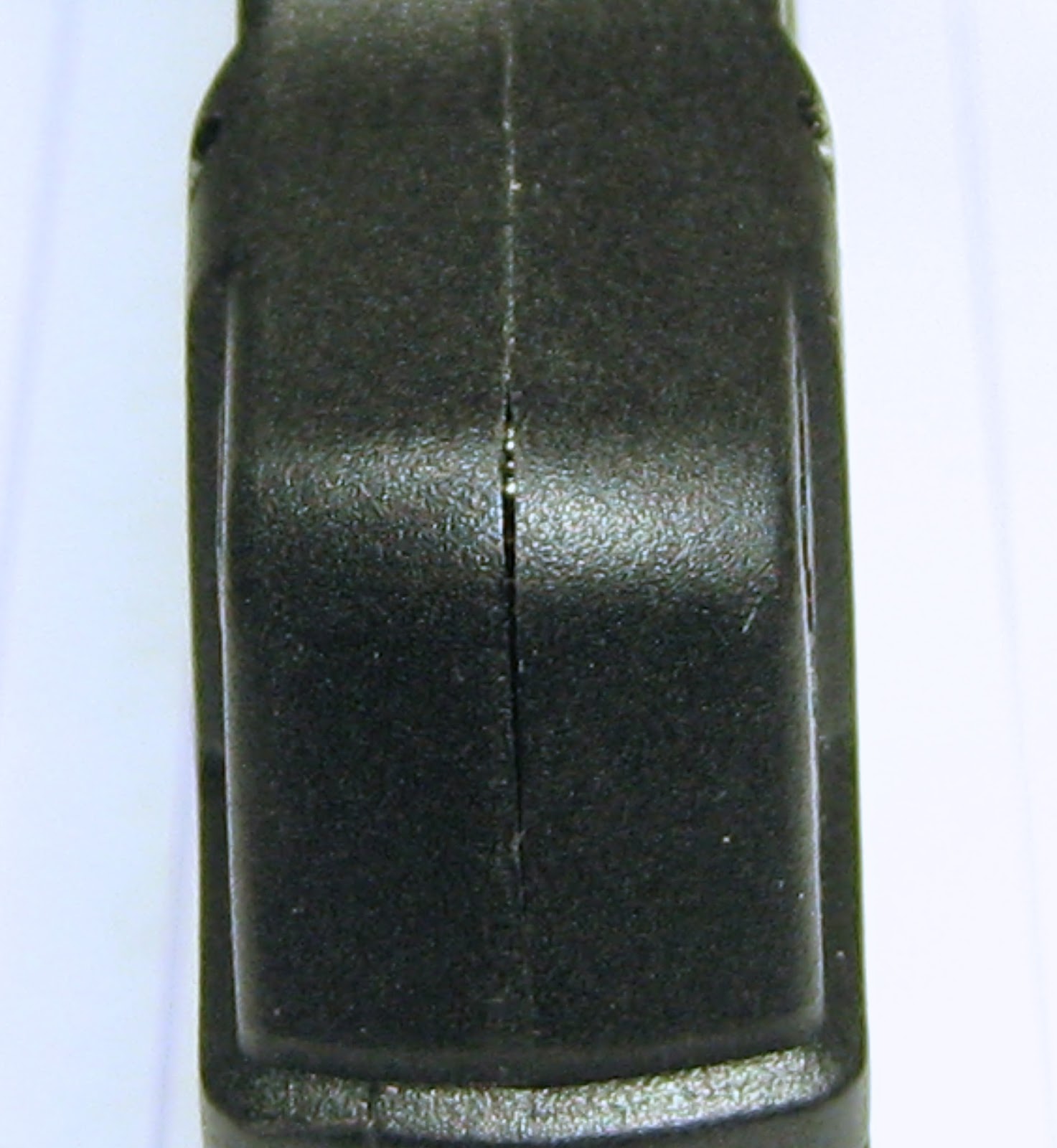
As you can see from the photographs below, I was unable to get the Defender's case to come completely together, even while forcing it by pinching it very hard while tightening the machine screws. I tightened the screws as much as I dared and still I could not get the gap to close. (See the photos below) I removed the Defender and checked for anything that might be keeping the sides from mating properly. The edges were both smooth and I could find nothing that might prevent the halves from closing. So, I tried another method.
| The Defender gap |
| Defender gap, end view |
| The solution. Clamp the ends while installing and tightening the screws. |
I was able to get most of the gap closed, but there still remained a small opening at the end of the sight casing. I suspect this is a molding problem resulting from not having exactly flat and true mating surfaces on the two parts. If I were to keep this particular unit on my gun, I would find some plastic filler and fill in that gap to keep it water tight. Of course, this would make it more difficult to remove and replace batteries, for example. You'd have to re-seal it each time.
| After clamping |
Below, showing the uneven mating surfaces on the Defender, and the position of the push-button activation switch. It is set into a small cavity cast into the sides of each casing to prevent accidental activation in a holster, for example.
| Defender activation switch |
As a comparison of the end mating surfaces, below is a photograph of the LaserMax CenterFire unit on the LCP showing a clean and precise mating surface.
| LaserMax CenterFire end view |
One of the biggest issues laser sight makers have in selling to people who are interested in trying them for their carry guns is that of holsters.
If a person buys a gun with a laser attached, or is getting an aftermarket laser for a new gun for which he or she has no, or few, holsters, this is not so much of a conundrum. However, most of us have a few carry guns already, and more than one holster for each. I have too many holsters for my guns, and from what I read, I am not unusual in this. Hickok45 even did an entire episode devoted to the holsters in his 'holster box'. I'm not that far gone, but I'm not that far behind either.
So, I think it is proper to include the holster question, briefly, in this comparison. I venture the opinion that if one already has a holster that will fit a LaserMax equipped handgun, getting a Defender equipped gun - the same gun, of course - to fit that holster depends on the holster. A holster made from heavy leather, like this Bear Creek pocket holster below, would not work. It would be almost impossible to re-mold this kind of holster to fit anything but what it was designed for. I've put the Defender-equipped LCP into this holster to illustrate the point.
| Defender equipped LCP in a Bear Creek holster moulded for the Crimson Trace Laserguard |
However, a holster, like this Remora with attached magazine pouch, will easily accommodate the LaserMax Centerfire, and the Crimson Trace Defender, and the LaserGuard for that matter.
| Defender equipped LCP in a Remora holster. This holster will accommodate all three lasers, the LaserMax Centerfire, the Crimson Trace Laserguard and Defender. |
I favor back pocket carry for the LCP, when I go that style, and the Uncle George is my choice for a great holster. It's 'heavy' enough to securely hold the pistol and prevent printing, but 'light' enough to easily draw from while it is in the pocket, and the leather can be somewhat re-molded to fit a slightly differently sized and shaped laser. Following the directions on Uncle George' website, I used a hair dryer to heat and re-mould this holster to fit the LaserMax Centerfire even though it was originally made for the Crimson Trace LaserGuard. However, trying it with the Defender shows me that the Defender is just too bulky to re-mold for it.
| Uncle George back pocket holster made for the Crimson Trace LaserGuard, which has been slightly re-moulded to fit the LaserMax CenterFire sight. The Defender, shown here, is too large for the holster |
| Another view of the Defender in an Uncle George. |
Last, I put the Defender equipped LCP in my Hay's cross draw holster. It's not in there all the way and it would probably work, but that would not be up to the standards I require in a self-defense holster.
So, the conclusion is that if one has a holster made for a laser gun already, even a Crimson Trace unit, the Defender might, or might not fit, or be made to fit. In my experience, a LaserMax CenterFire has a better chance of fitting into a holster made for the Crimson Trace LaserGuard, or vice versa, than does the Defender.
If you are in the market for either one of these sights, plan on also getting a quality holster for it. Both LaserMax and Crimson Trace can point you in the direction of good holster makers who make quality products for each.
Function
Well, where the rubber meets the road, or the bullet meets the target, is the end result of this exercise in laser sight aids.
Both companies have essentially the same laser units in their offerings, functionally speaking. Laser power is constrained to be no more than 5mW in power with a wavelength of 650nm (nano meters). Their beam shapes are identical and both emit in the red spectrum.
Once switched on, there is not much to choose from between the two. In low light or darkness they are bright and easy to see. Also under most lighting conditions, especially at expected self-defense distances, seven to ten yards, they are readily visible even in sunlight.
In general, my opinion is that it is not a good thing to become heavily dependent on a laser sight on a self defense handgun. There are times when it can be very useful and provide a distinct advantage, but there are also times when it's something else to operate and for the eye to pick up that red dot. Getting a shot off as quickly as possible may be critical in certain instances, and there would be no time for dot acquisition. Given that laser sights are another option in one's self defense repertoire, acquiring and training with a laser sight is a good thing. I especially think they are most valuable when coupled with a small gun, like the LCP which is difficult enough to shoot accurately in the first place.
I think the biggest factors separating the LaserMax CenterFire and the Crimson Trace Defender come down to quality of construction, integration with your chosen firearm and personal preference between the two actuating mechanisms. In my opinion, after using both, I think the LaserMax Centerfire is the best choice.
The quality of construction is demonstrably better than Crimson Trace's current effort with the Defender.
I don't care for the bulky shape of the Defender, preferring the smoother integration of the CenterFire with the LCP, but this is, of course, solely a matter of personal taste.
Lastly, having spent a number of years as an engineering technician I am inherently suspicious of mechanisms with too many moving parts. The Defender's spring-loaded push-push switch is more likely to fail than the CenterFire's simple push on, push off switch. It probably won't happen, but Murphy has taught me that things do happen and they mostly happen at the worst times. Simply put, in the CenterFire's simple, springless on/off switch, there is no spring to fail.
I want to express my profound thanks to LaserMax and Crimson Trace for stepping up and providing these laser sights for a comparison evaluation. It has taken a number of months to get everything in place and I hope the result is worthwhile and helpful to anyone considering a laser sight for their self defense handguns. Both Crimson Trace and LaserMax are small companies dedicated to designing and producing quality products and their customer service and relationship management staffs have been helpful to me in this project.
Please leave any comments and I will respond as best I can to them.
Labels:
comparisons,
Crimson Trace,
LaserMax,
lasers,
LCP,
Ruger
Monday, July 8, 2013
Crimson Trace Is Participating
Crimson Trace has agreed to participate in my comparison review project by providing a new Defender series laser sight for the LCP.
After a number of missed phone calls, missing emails from CT to me (CT rep Mike Faw sent timely replies to my queries but my mail server decided to route them to the trash folder. Why? Unknown at this point, but I am investigating.) I had a conversation with Mr. Faw this morning - thanks to his call and followup to our interrupted conversation - and he will be sending a Defender sight.
I will be able to perform a direct comparison and analysis of the Defender and the LaserMax CenterFire for the same platform. This is good in more ways than one. Not only are the two companies now in competition in exactly the same market niche - add-on laser sights for the popular series of light and compact carry pistols - but this is a very important improvement for these types of self defense handguns.
I will speak to the Ruger LCP, being I have that particular weapon, and because it is extremely popular.
The LCP, and those like it, are difficult to shoot for most people in two regards. The form factor being very small, coupled with a long double-action type trigger, make the shooter's grip and trigger action very important, and, without significant practice, difficult to control properly. This coupled with the extremely short sight radius and rudimentary sights provided on the gun, makes anything other than 'up close and personal' shooting distance accuracy problematic.
Add these factors to a highly stressed and emotionally charged self defense shooting scenario and the likelihood of missing the target and hitting something or someone else you don't intend to shoot very high. Hence, the need for better sights.
In my view, this is where personal laser sights on these types of handguns really come into their own. It's not that the shooter can get a highly accurate shot placement with the laser, it is that the average gun owner can get shots at least on target, speaking of a realistic self defense scenario where you are trying to hit the center of mass of an assailant. In fact, it gets better because the shooter is not required to bring the weapon up to a "standard" ready to fire position with good sight alignment. Such a move may not be possible for a number of reasons in a real situation. Just getting the laser dot on the target is enough.
So, with LaserMax and Crimson Trace now offering sights in the same market niche, aimed for the same customers, I will be able to do a thorough comparison and report on my findings.
As to the cooperation of the companies involved, at this point, I have them about even considering the fact that both were undergoing certain organizational personnel changes when I first approached them about this project. This created delays that were not reflective of the two companies customer service practices and philosophies.
I will soon be able to begin and bring you the ongoing comparisons and results of the efforts of these two companies and their products.
After a number of missed phone calls, missing emails from CT to me (CT rep Mike Faw sent timely replies to my queries but my mail server decided to route them to the trash folder. Why? Unknown at this point, but I am investigating.) I had a conversation with Mr. Faw this morning - thanks to his call and followup to our interrupted conversation - and he will be sending a Defender sight.
I will be able to perform a direct comparison and analysis of the Defender and the LaserMax CenterFire for the same platform. This is good in more ways than one. Not only are the two companies now in competition in exactly the same market niche - add-on laser sights for the popular series of light and compact carry pistols - but this is a very important improvement for these types of self defense handguns.
I will speak to the Ruger LCP, being I have that particular weapon, and because it is extremely popular.
The LCP, and those like it, are difficult to shoot for most people in two regards. The form factor being very small, coupled with a long double-action type trigger, make the shooter's grip and trigger action very important, and, without significant practice, difficult to control properly. This coupled with the extremely short sight radius and rudimentary sights provided on the gun, makes anything other than 'up close and personal' shooting distance accuracy problematic.
Add these factors to a highly stressed and emotionally charged self defense shooting scenario and the likelihood of missing the target and hitting something or someone else you don't intend to shoot very high. Hence, the need for better sights.
In my view, this is where personal laser sights on these types of handguns really come into their own. It's not that the shooter can get a highly accurate shot placement with the laser, it is that the average gun owner can get shots at least on target, speaking of a realistic self defense scenario where you are trying to hit the center of mass of an assailant. In fact, it gets better because the shooter is not required to bring the weapon up to a "standard" ready to fire position with good sight alignment. Such a move may not be possible for a number of reasons in a real situation. Just getting the laser dot on the target is enough.
So, with LaserMax and Crimson Trace now offering sights in the same market niche, aimed for the same customers, I will be able to do a thorough comparison and report on my findings.
As to the cooperation of the companies involved, at this point, I have them about even considering the fact that both were undergoing certain organizational personnel changes when I first approached them about this project. This created delays that were not reflective of the two companies customer service practices and philosophies.
I will soon be able to begin and bring you the ongoing comparisons and results of the efforts of these two companies and their products.
Saturday, June 29, 2013
A Not So Good New Product from Crimson Trace
![]() |
| Crimson Trace's new Defender Series Laser |
![]() |
| Lasermax Centerfire |
There are times when you have to wonder if people designing and approving new products for a designated market really have a good grasp of what people want and, more importantly, what people need. In this case, I believe Crimson Trace has missed the boat. In fact, they've gone and built a completely different boat designed for people who haven't expressed much of an interest in where the boat will be going.
Crimson Trace is noted for, among other things, building handgun lasers that have their "instant on" feature. An actuation switch mounted on the grip so that it comes on with a firm shooting grip. Many people like this feature. Many people don't.
Laserguard makes a similar laser with the activation switch in front of the trigger guard so that it is easily actuated, or not, by the shooter whenever her or she wishes to turn it on. Many people like this. Many people don't. So, both companies have staked out their markets for this type of laser sight.
Now, Crimson Trace has introduced the Defender Series which is, except for the form factor, basically the same sight as the Laserguard Centerfire. The actuation switch is different in shape and color (it's red on the CT, which is nonsensical to me since the shooter won't be looking for the switch anyway), and the laser shape is different from the Centerfire and from CT's own Laserguard, which I think is a big mistake and a significant issue.
Why? First, and least important, it signals a weakness in their design and innovation concepts. Functionally, the Defender is the same as the Lasermax Centerfire, only it's newer and going up against an established competitor with a proven track record.
Second. Price competition I think. The Defender and the Centerfire are both priced about the same, but CT's Laserguard series is significantly more costly.
Third. And most important from the perspective of people who conceal carry pistols with laser sights, now you are going to have to buy yet another holster.
If you are going to introduce a significant improvement in handgun laser technology and adaptation to the handgun, why reintroduce the wheel that has already been invented by someone else? I think this is basically a move to get some of Lasermax's Centerfire business.
As I've said directly to representatives of Crimson Trace and Laserguard, do your yourselves and us a favor. Develop and provide a reasonably priced semi-automatic handgun laser that does not require the customer to invest even more money in another holster. If you carry concealed, holsters are a big deal. Good ones are expensive, so take that laser sight MSRP of $129 and add about $80 for another holster, or $160 for two. Now, you are spending $200 to $300 for a $100 laser.
At the least, CT could have kept essentially the same form factor as their Laserguard with the change in switch position so that for those who have Laserguards, another holster would not be mandatory. Notice, too, that the Defender's form factor is such that it won't fit a moulded holster made for the Centerfire. So, you can't even try one out in your existing Centerfire holster.
In my opinion, I don't see any reason to go with the Defender Series since Lasermax is already there, and has been for some time with their switch-activated, under-the-slide laser, the Centerfire.
Monday, June 24, 2013
The Companies Behind the Lasers
![]() |
| From Crimson Trace's "Contact Us" page |
![]() |
| Lasermax Genesis |
As I noted earlier, when I began this project, the companies that make and stand behind their products are probably more important than the products themselves. Of course it is important that the products do the jobs they are meant to do, and that is difficult enough. Being open to customer inquiry, criticism, ideas and complaints is just as important. If your product is showing some defect, or perhaps a design flaw experienced by some users, it is vital that the company listen to those people. Perhaps there is little to be done, or it turns out to be a personal matter not directly related to the design and manufacture of the product, but sometimes there are changes and improvements that need to be, and can be done.
Competing products also live by reputation, especially in the world of laser sights. People now communicate frequently and at awesome volumes, thanks to the internet, email, blogs, forums, and so forth. Rumor and fact are often not distinguished and both can go "viral" over the internet. It is very difficult for a company to reacquire a former customer once the customer gets a bad taste for the company or product, whether that is justified or not. In the large corporation I retired from, the rule of thumb was it is ten times harder to regain a customer than to get a new one. So, for a continuing business striving to compete and build a great rep, customer service is more than a buzzword.
So, the way in which the two companies that are the subject of my comparison review of laser sights work with and relate to their customers, and to their reviewers is an important part of their reputation in the gun world. (Recall that LaserLyte has disappeared from the scene after an assurance that they would participate. That, in itself, is not a good sign for me.)
As was true with Lasermax, there has been an organizational change with Crimson Trace. I've contacted the new person who coordinates review projects in order to inform him of what I have now, how I intend to proceed and if Crimson Trace wants to more fully participate.
According to Crimson Trace's Contact Us page, this is what they have to say about customer service:
At Crimson Trace, our goal is not to meet your needs. Nor is it to exceed your expectations. Our goal is to create a “Raving Fan” out of you. To us, customer service isn’t simply answering your questions, tracking your shipment, or talking you through installation. To us, customer service is making your experience with our brand shine so brightly that you’re amazed. That you’ll tell others about your experience. That you’re not just a customer. You’re a Raving Fan!
From the Lasermax site, their Contact page:
Contact Us:
Have a question? There are lots of ways to reach out to LaserMax and we
would love to hear from you. Use any of the methods below and let us provide
the exemplary customer service you've grown to expect from LaserMax.
would love to hear from you. Use any of the methods below and let us provide
the exemplary customer service you've grown to expect from LaserMax.
I'm looking forward to seeing how this works.
Thursday, June 13, 2013
Let there be Light and Innovative Mag Carriers
![]() |
| Centerfire |
Tight, red beams of light. Last week I received a number of laser sights from Lasermax for my evaluation project. I have been fitting them to my various handguns, getting used to them, removing and replacing them to see how that operation goes, and fitting them to my Remora holsters. One of the main reasons I'm using Remora holsters for the laser equipped pistols is that with a little modification by me - removing a couple of strategic seams - they fit laser equipped guns perfectly. For those of us who have holsters for our non-laser guns, this is a good thing, especially as the will still readily accommodate the same pistol with or without laser sights.
I will be reporting on the Lasermax Centerfire laser sights for the LCP and the LC9 (which also fits the new LC380) pistols, and the Lasermax Micro for the rail equipped SR9c.
![]() |
| Micro |
I will have more detailed comparison information as time goes on, and hopefully a few more holster choices for both sights.
I have learned one thing already - I feel that having a laser sight on a small self-defense handgun is a positive factor. There have been many discussions regarding the usefulness of lasers on handguns. Many opponents cite factors such as "something else to fail", "dependence on acquiring the 'red dot'", "usefulness in the daylight", and so on. I will be addressing these objections later, but I will say now that I'm thinking that it is not wise to discard a option that stacks the odds more in your favor. Especially since I believe it is incumbent on the person who takes the responsibility of carrying a weapon to be able to only hit what one shoots at. There is no excuse for putting innocent people in danger. To this end, a laser sight can pay big dividends under certain situations. Considering that the vast majority of handgun owners are mediocre to poor marksmen in the ordinary case, and many will become poor to downright dangerous when the adrenaline is surging, the heart pounding and you see the elephant, having a laser to guide your shots is a really important advantage.
More light on this subject a little later.
Kytex Mag Carriers
I have the opportunity to try out a couple of the nifty and innovative Kytex magazine carriers. These are truly the most interesting and innovative mag carriers going. Check out the video on their various models here: http://www.youtube.com/watch?v=APLd4SopfP8
And their own website at: http://www.kytexgear.com
These are made from a single sheet of kydex, folded ingeniously to create the mag holder itself, with automatic tensioning that still releases the magazine with little effort but keeps it firmly in place, and folds around to create the belt clip. No brads, screws or seams. One piece. Light weight and easy to use. Additionally, the design ensures that the magazine is always carried in the correct orientation, specified by you. Bullets forward or back. Your choice.
I have tried to find some flaw with this design or its execution. I at first thought that the little tabs on the ends of the belt clip would make it difficult to put on. No. In fact, they act as a kind of guide to help move it initially over the belt, and handy places to put finger leverage when removing the carrier. And, most helpful, keep the carrier on your belt so it can't slip up and over. Very cool.
So, I can't find anything at all to complain about. Even the price is less than most kydex makers charge for their wares.
My recommendation - if you need, or just want, the best kydex mag carrier that I have tried, get a Kytex. Or two or three.
Sunday, June 2, 2013
Lasermax Update!
I can begin this post with the assurance that Murphy is alive and well. As you probably know, Murphy's Law states that if anything possibly can go wrong, it will.
After moderating many pro and con laser sight discussions on the old Elsie Pea Forum, and being pretty much on the fence myself, I concocted the idea that if I could get samples of the different, popular laser sights for a handgun, I could evaluate them, test out their usefulness for me and report on what I found. I got a Crimson Trace laserguard pretty quickly. The Laserlyte people promised a sample, but then didn't come through or respond to my subsequent emails. The Lasermax folks were cooperative and got me to the right person to set this up. Then, things fell between the cracks.
After a few emails, I discovered that the original person handling these situations was no longer with the company, and her replacement made contact with me. She liked the idea and we began to discuss how the evaluation and review would be handled. Then more delays. I was getting frustrated with the lack of progress and posted about this here. Then, I re-established contact and we both discovered that Murphy had been at work.
The order meant to send the evaluation items to me had entered their provisioning system, then got canceled. No one knows why as yet, but they are checking into it. They obviously don't want that happening in their ordering and provisioning systems. Then, my contact in Public Relations discovered that my later emails were being directed into her junk mail folder. I wasn't the only one, it turned out. Other important contacts' emails were also being mistakenly routed to the junk mail folder. Strangely, this exact thing had happened to me on a day before. Sometimes, software is too smart for its own good.
Anyway, I think we are back on track. As I see it, this was one of those things that sometimes happens in business, and life, where a few things get off track due really to no one's fault. I should have some review items from Lasermax soon, and I can get my comparison study underweigh.
I want to thank Lasermax for being responsive and tracking down the issues that we experienced. I think one big lesson in all this is to work with other parties to resolve issues instead of jumping to conclusions and slamming people or companies without justification. It resolves around assumptions. Almost every time I've made an assumption about an issue and acted on it, without asking questions and trying to understand all of the facts and circumstances involved, I've made a mistake.
So, a big thank you to Lasermax for hanging on to good customer service like a dog on a bone. It's good to find a company that understands their customers are what keeps them in business.
Monday, May 20, 2013
Lasers: no light at the end of the tunnel
As I posted here earlier, I am trying to get a detailed comparison going with the major laser sight manufacturers. I'm a normal guy, or so some people have said. (Don't ask my kids.) I want to do a "normal" evaluation conducted over time by a representative civilian legal concealed carry person. That would be me.
Crimson Trace was the first to respond. They were quick and effective, sending me a unit for my Ruger LCP. Nice. LaserMax responded, and then the long, long saga began. Some of that is detailed here. Unfortunately, it is still going on. I've had numerous communications with LaserMax, both via email and phone. They are very nice and accommodating, but have somehow run into continuing difficulties in getting their promised units to me for evaluation.
I understand how issues come up in business. After all, I spent fifteen years in a giant corporation dealing with issues resolution on a daily basis. However, I was usually able to get the issues resolved, and to keep the effected people in touch with what progress was, or was not, being made. LaserMax is, I think, trying to resolve the issue with supporting my evaluation and review of their sights, but getting information from them is like the proverbial water from a stone. Not happening.
If I get no action this week, I will have to call off the laser sight review and evaluations. I'll do more postings about Crimson Trace, the sight and the company, but I may not be able to compare the plusses and minuses with LaserMax's products.
Oh, and Laserlyte.... they said, sure, we'd be glad to participate. Then I never heard another word.
Crimson Trace was the first to respond. They were quick and effective, sending me a unit for my Ruger LCP. Nice. LaserMax responded, and then the long, long saga began. Some of that is detailed here. Unfortunately, it is still going on. I've had numerous communications with LaserMax, both via email and phone. They are very nice and accommodating, but have somehow run into continuing difficulties in getting their promised units to me for evaluation.
I understand how issues come up in business. After all, I spent fifteen years in a giant corporation dealing with issues resolution on a daily basis. However, I was usually able to get the issues resolved, and to keep the effected people in touch with what progress was, or was not, being made. LaserMax is, I think, trying to resolve the issue with supporting my evaluation and review of their sights, but getting information from them is like the proverbial water from a stone. Not happening.
If I get no action this week, I will have to call off the laser sight review and evaluations. I'll do more postings about Crimson Trace, the sight and the company, but I may not be able to compare the plusses and minuses with LaserMax's products.
Oh, and Laserlyte.... they said, sure, we'd be glad to participate. Then I never heard another word.
Friday, April 5, 2013
The Endless Carry Argument: which gun? what caliber? what self defense round? which holster?
![]() |
| Uncle George's Wallet Holster |
I've illustrated this post with a photo of one of Uncle George's wallet holsters made for the Ruger LCP because carrying a handgun for self defense is a simple and basic act, and this is about as simple as it gets. Anyone - male, female, big, tiny, it doesn't matter - can carry one of these setups almost anywhere without being noticed or uncomfortable. The Ruger LCP weighs 9.4 ounces, 10.0 with a Crimson Trace laser sight installed (as above). It's a little over five inches long and less than an inch wide. It is built for concealment and for carrying. It, and other similar 'pocket pistols' usually are chambered for the .380 caliber round (also called the 9mm short). With a good factory load, designed for self-defense, such as the Hornady CD or perhaps the Speer Gold Dot (and similar ammunition), it is an effective self defense weapon.
So, what we have here is a lightweight (Light), small (Compact) Pistol designed to be carried for self defense by practically anyone. This, evidently, drives some self-styled 'gun experts' crazy.
They can't so much complain about the polymer frame, since many of the handguns they prefer incorporate that in their builds, but seemingly everything else is fair game to them: caliber (too small), bullets (not heavy enough, not designed right), sights (poor iron sights that aren't adjustable), small capacity (seven rounds is not enough), not durable enough (will suffer problems if it's shot too much), and so on. To further disparage these kinds of self defense weapons, they have labeled them "mouse guns". Must mean that they are only good for plinking mice, or that mousy people use them. Not sure on that. And, they probably aren't either.
A few examples of the "experts" recommendations for self defense carry:
- If the caliber of your pistol doesn't start with a "4" it isn't big enough.
- Double-stack magazines are required so you can carry enough ammo without having to frequently reload.
- Your self defense gun must be 100% reliable under all conditions.
There are more, but those will do for illustration purposes.
In my opinion, basically all of those arguments are bogus when it comes to self defense. The two critical factors are, 1. carry a gun. All of the time. It is a true statement that you better have one when you need one.
2. hit only what you intend to hit when you have to shoot.
If the caliber of your pistol doesn't start with a "4" it isn't big enough.
It is obvious that if you pull a gun and fire off a round (or twelve, even) and don't hit the threat, you've done yourself no good and possibly have injured, or worse, an innocent person. No matter what the caliber of the gun, velocity or impact of the bullet, your self defense gun is useless unless you can hit something with it. Reliably, accurately and repeatedly if necessary.
Unless one is a practiced, experienced shooter, shooting a large caliber handgun is harder than shooting a handgun of smaller caliber and power. Most people who carry for self defense are not practiced, experienced shooters and are not going to become one either. They, hopefully, practice enough to be comfortable with their weapon and to be accurate enough for the ranges and target sizes that would be appropriate for most self defense situations. Most of these people shoot a reasonably sized handgun - .38 special, 9mm, .380 calibers. They are big enough to do the job, but not so heavy, noisy and recoil producing to be hard to shoot.
Double-stack magazines are required so you can carry enough ammo without having to frequently reload.
Double stack magazine handguns are bigger and heavier than single stack guns. As a consequence, they are more uncomfortable and heavy to carry and more difficult to conceal. Hence, they tend to not get carried as a regular thing. Your double-stack .40 caliber pistol is doing you no good as a self defense weapon while it's in your car or home in the safe. Besides, when are you going to really need a fifteen, sixteen or seventeen round capacity in the self defense world? I supposed if you were attacked by a gang and were forted up behind a car, then, maybe. You'd likely be outgunned anyway so things wouldn't be turning out well for you.
I think the notion of being in an extended shoot out is common because that is what TV and the movies show us. But, that's really the rare exception when citizens are forced into self defense shooting. Read up on it. Most scenarios involve one or two rounds being fired. It's rare that more than five or six are expended in these situations. They start quickly and end quickly with people running away or stopping their aggressive behavior because they are suddenly dealing with a bullet wound or two.
You can easily carry a spare single-stack magazine along with your smaller self defense weapon so you'll have a reload in the unlikely event you will need one.
Your self defense gun must be 100% reliable under all conditions.
That would be nice, but face it, no machine is 100% reliable even under good conditions. It's the nature of the beast. It's the world of Murphy's Law. I know shooters who have fired thousands of rounds from their handguns and think this is a guarantee of reliability, that the gun is going to go bang the next time they pull the trigger. Think about it. Just because the machine has not experienced a failure before does not mean it's never going to fail.
Check your self defense gun by shooting regularly, but don't burn through hundreds and hundreds of rounds. Shoot it enough to be sure it's running well, like it should, then carry it. Maybe go out and practice once a month to keep your proficiency and to exercise the gun. You will soon know if it has an endemic or recurring problem. Send it back to the maker and have them fix it. Use another self defense gun in the interim.
The reliability factor is one of two that mitigate for carrying a backup gun. In the unlikely event that your pistol malfunctions at exactly the wrong time, you may have the opportunity to go to your backup. Odds are that the two guns won't fail at the same time. The second reason is that you may not be able to get to your primary weapon due to being injured, having the gun taken away, dropped, or perhaps your assailant in on top of you wrestling with your gun, or preventing you from getting to it. You may have the option of going for the backup.
In the real world, it is impossible to prepare for all contingencies, just as it is impossible to carry a gun that is 100% reliable. You can narrow the odds and put survival more in your favor by understanding that a reasonable and rational level of preparedness is attainable and sustainable if you only do a few things.
1. Find a handgun that suits you and which you will carry at all times where legally allowed.
2. Keep that gun in good condition.
3. Practice regularly so that you can access it and shoot it accurately under self defense conditions. Practice at short ranges, say, the distance between two walls in a regular room in your house. Become good at hitting an area the size of the human torso.
That's it. Shooting an assailant a number of times in the torso will definitely put the odds of survival in your favor. Of course there are true stories of men being shot multiple times with decent caliber handguns, mostly by law enforcement officers, who still fight back and don't seem to know they are shot. This is the exception however. And, when you think about it, if you should encounter one of those people, it doesn't much matter if you are toting a Model 1911 .45 automatic or a .380 LCP. But one thing for sure, I'd rather reach for and use my .380 in a circumstance like that and hope my accuracy was enough to stop the threat, than to be throwing rocks, glasses or chairs as my self defense weapons.
If you think the circumstances may demand it, you can always carry a larger gun along with your primary self defense weapon, but you don't have to make it a regular thing.
Realistic self defense carry will keep your armed and prepared in all situations. You probably won't be ready for the zombie apocalypse, but you will be ready to deal more effectively if you are seriously threatened.
Monday, March 11, 2013
Elsie Pea; Block Training; Police Chief; Lasers again
![]() |
| My Moderator's Logo from the old Elsie Pea Forum |
Not too long ago, last year, the old Elsie Pea Forum (LCP) was sold off to an organization that runs forums. Many of them. The Elsie Pea Forum had grown to over 10,000 members and it was all five of us could do to keep things in check. We prided ourselves in stopping spam before it got started, keeping the atmosphere polite, if not cordial, preventing flame wars and keeping posters to the topic: no religion, no politics, no hatred. I will admit that there were times when this was trying, but if truth be told, the members themselves were very good about policing the forum and keeping troublemakers in line. If the members couldn't reign them in, the moderators did.
I was a big fan of Have Gun, Will Travel when I was as kid. I still think it was a TV show ahead of it's time, so I picked the logo, above, as my moderator calling card. I still moderate, but a much smaller forum where many of the Elsie Pea refugees hang out. http://www.compactcarryforum.com
Have Gun. Will Carry
Of course, it is more than that as anyone who has carried a concealed handgun for any time will tell you. Lately, I've been around the block more than once over dealing with the extra baggage that comes along with concealed carry. Like many of you, I have a drawer full of holsters (and I only have three carry guns), extra magazines, laser sights, night sights, special springs and recoil rods, gun safes, various cleaning do-dads and storage and carry boxes.
Now, the entire picture is complicated by my use and evaluation of laser sighting devices. Saving the topic of the utility and usefulness of laser sights on a concealed carry handgun for another time, one big factor became apparent right away. When I received a Laserguard from Crimson Trace for my LCP I was faced right away with the fact that, other than a Versacarry rig, I had nothing to carry it in.
At this point, over the last two months with the CT, I have had it on and off the gun three or four times. I do now have a Jeff Hays cross draw OWB holster, which is very nice indeed and works better than any cross draw holster I've found so far, and I have acquired a Remora with attached mag pouch for it. However, my other holsters, carefully pared down from many I tried that fit right, work right and will last a long time do not work with the Laserguard. Hence, off with the laser and, like today around the house, on with the Bullard Bodyguard and LCP.
Having a laser on my gun is pretty nifty, although the jury is still out as to whether a Crimson Trace or LaserMax will find it's way on one of my carry guns permanently. But not being able to carry it as I wish, in the style and quality of holsters that I require, is a big stumbling block. But, I'll report more on this after the LaserMax units arrive for testing alongside the Crimson Trace.
Block Training
I got an email, and later a follow up phone conversation, with a small group nearby composed of experienced former LEO and NRA Firearms Trainers who have come up with a very good idea. I call it Block Training. It works like this. They have essentially taken a general two-day intensive handgun and self-defense training class and broken it down into 2 to 2 1/2 hour blocks. This way a person can afford to begin improving his or her real-world handgun self-defense skills without having to pony up a few hundred dollars for the course, lodging, meals and a thousand rounds of ammo all at once.
I hope to be able to attend one of the first class blocks and report on this concept in more detail here.
Police Chief
The Chief in one of the local towns nearby is leaving after a long military and police career. One of the more interesting things he had to say was that he, along with many other in law enforcement, support the 2nd Amendment right to keep and bear arms. To walk the talk, he is planning to set up and conduct concealed carry classes in our area. Now, if you want to take one, it is at least a two hour drive, and if you don't want to wait until they get around to holding a class within that range, you can drive another hour or two. I'm looking forward to that and it's got me thinking about getting my instructor qualifications and helping out.
Lasers Again
I've already whined about lasers and holsters, so I'll spare you that. The update is that I am waiting on what I have been assured by LaserMax is a package with at least one laser sight evaluation unit, plus other materials. If I don't see it this week, I'll be following up with them. Once that arrives, and the snow melts and the ground dries, I will be able to get some range time with both models and have some personal experience that I can hopefully translate into useful information.
Thursday, December 13, 2012
A Humbling Lesson
A Crimson Trace Update
After having the Laserguard installed on my LCP for a while now, I have been getting used to the feel, activation and use of the laser mounted on the gun. Theory aside, the experience is teaching me new things, not all of them flattering. First, contrary to what I have read on numerous gun forums about acquiring the "little red dot", I have absolutely no trouble finding the red dot - and, it's not so "little" either. In fact, it is very bright under most circumstances, most especially in low light conditions. Actuate the laser, and your eye immediately goes to the bright red dot which should be on the target, drawing your attention to the target immediately, not to looking for a 'sight picture'.
Another lesson for me is that I am far less dependent on obtaining a standard site picture, which requires that I raise the gun to eye level and hold it relatively steady while I line up the front sight on the target. While I consider this to be a good and useful tactic, and strive for it even with the laser installed, I have learned that it is not a necessary component of my aiming technique, especially under self-defense situations. Let me explain.
Training and muscle memory are extremely important in getting the body and mind to act as they should under stressful situations. Acquiring your firearm and bringing the pistol to bear accurately is a solid requirement in those situations, but as you can imagine, there are times when one will not be able to perform this routine as it is normally practiced. You may be running. You may be down. You may be blocked somehow from getting into the standard sight-acquisition/shooting posture. There may just be no time to get there. Such situations call for what is termed "point and shoot" techniques. The issue with that is without some indication of where the muzzle is pointing, when a standard sight picture is not possible, you really don't know what you will be hitting when you pull the trigger.
I have learned, by using the Laserguard, that I do not instinctively aim where I think I am aiming when practicing 'point and shoot'. Like, bringing the pistol up to the fire position, without getting a normal front sight picture (maybe extending it quickly from the waist to mid height while looking at the target) the laser shows me that I am almost consistently aiming too low, and often to one side, off my intended target. Why does this matter? Well, for example, if I was sitting and had to draw and fire very quickly without coming to a sight picture - time being of the essence and the threat being close and moving toward me - with the laser, I now can tell when to fire. The red dot is on the target, regardless of where my gun is positioned, I know I am going to hit the target pretty close to that dot, not fire into the wall or, worse, someone else.
I am amazed that even in such close proximity, one's aim can be off enough to miss a center-of-mass target when doing this quick drill. I better understand the statistics that relate the fact that trained shooters, we are talking about law enforcement and military trained shooters, often miss their targets even when they are within five yards or less, sometimes much less.
So, one good lesson I have learned from using the laser without, so far, firing a shot, is that my belief in my natural ability to point-and-shoot is misplaced. I need practice getting on target with that method and the CT Laserguard revealed that shortcoming, and will be a good aid in improving my accuracy. I also suspect, that by so practicing and developing the reflexes and muscle memory by using the Laser, I will still be a better shot if I should have to make that shot without benefit of an active laser sight.
You are never too old to learn something new.
Subscribe to:
Posts (Atom)


.jpg)