About SD Carry

As a young boy in Texas, I grew up with guns. They were basic tools, much like my grandfather's mitre box or pipe wrench, there to perform specific tasks when called upon. I was taught gun safety by virtually every male adult in my family. I spent eight years in the US Navy operating and maintaing various guns from .30 caliber to 5" rifles.

After a few years as a moderator on a popular gun forum, I learned that there is much disinformation, prejudice and plain ignorance about guns posted constantly on the internet.

This blog is dedicated to sharing worthwhile information about the increasing acceptance and practice of legal concealed carry in our country. There is much mis-information and wild opinion about this topic among its practitioners and the public in general. The moral, social and legal responsibilities of concealed carry are immense and must be understood and practiced by all who legally carry a gun.

There is also a vast amount of practical and useful information about carrying and the weapons themselves and I hope to be able to share some of that here. Your comments are welcome, but will be moderated by me before appearing on this blog.

Stay safe.

Other Pages

Showing posts with label comparisons. Show all posts

Saturday, October 12, 2013

Lasers - Pick your color, red or green

I was fortunate to be able to test two excellent lasers from LaserMax for the Ruger LC9 handgun. Traditionally, the common laser light color offered for handguns has been red. I believe it is less expensive to produce, and smaller in form factor. Green laser light units can be bought, but they are sometimes significantly more expensive than the red light units.

Now, LaserMax offers both red light and green light lasers in the CenterFire model. As you can see from the photographs below, the two units appear almost identical. The sharp eye will notice that the green model is slightly larger than the red, although I found that this is really undetectable when on the gun. They mount and remove the same way and operate exactly the same. The only significant difference is the color of the laser beam itself.

LaserMax Centerfire. The red beam laser is attached. The green beam laser is below.

CenterFire red.
A look at the innards of the 'red'.

Both share this attachment method at the trigger guard.


The green.


You can see the size difference. The red is on top, green below with it's larger laser.

Side by side.
I have read that the green laser beam is preferred in daylight as it is easier for the human eye to discern. Maybe, but try as I could, I saw no appreciable difference. I tried them in bright sunlight and overcast days, and they were both readily seen by my old eyes.

Now, there may be some truth in the claim that the human eye is more sensitive to green light than red. Perhaps going from bright light suddenly to dark or near dark would make a difference in the color detection. I do know that some people say they see green better under all circumstances and prefer that color. If that is you, then LaserMax now offers an affordable, nicely made green laser for your handgun. If you are running a red CenterFire, there should be no issue with swapping it for a green in mounting or operation. Or, better still, for your holster collection.

Check out the specifications at Lasermax.com


Friday, August 2, 2013

Dueling Lasers: LaserMax & Crimson Trace


My first comparison and evaluation is of the LaserMax Centerfire and the Crimson Trace Defender, both solidly in a competing marketplace for the popular Ruger LCP .380 pistol. Crimson Trace has long offered one of their 'regular' grip-actuated LaserGuard units for the LCP, and have recently introduced their new Defender series. This product is priced and designed as a direct competitor to LaserMax's Centerfire sight. Both companies have kindly supplied one of each unit for the LCP for this evaluation and comparison.
LaserMax

Crimson Trace
You will notice that the form factors are similar, though different in important ways. The shooter actuates the laser with the index finger, which should be positioned over the switch on either laser unit if the draw is done properly and good gun handling is exercised.


LaserMax CenterFire actuation position


Defender actuation position


As the photos show, the switches on both laser units are designed to be used either right or left handed, which is good in general, and shows foresight by both companies to accommodate situations in which the shooter's normal gun hand is occupied or incapacitated. The difference between the two designs, LaserMax and Crimson Trace, is in the actuation - a two way push-switch that remains in it's position once placed there, and the spring-loaded push on/push off switch Crimson Trace uses.

Press the LaserMax activation button, which is the end of the switch that protrudes from either side of the sight, with either index finer (or any other you might need to use) and it switches the laser unit on. The switch remains in the closed position, powering the laser, until the shooter turns it off by pressing the switch rod from the other side. Easy enough to do with a two-hand grip. Simply use a finger on the other, supporting hand.

The Defender relies on a spring loaded push button, actuated from either side. One push and the laser is on. Another push, from either side, and it's off.

The only operational disadvantage I see at this point is that it is possible to inadvertently push the Defender's switch a second time, turning it off accidentally. I don't see this a high risk issue, the switch being rather small and tucked out of the way in a long indent in the casing, but the possibility is there and should be recognized.


The Innards

Below is a photograph of the LaserMax CenterFire units, the one on the left is sized for the Ruger LC9, the one on the right is for the Ruger LCP. They are identical, but one is slightly larger to fit the larger LC9, but the components and arrangements are the same. The LaserMax units are joined with larger self-tapping screws. The allen wrench is supplied to perform any sight adjustments necessary.


LaserMax for the LC9 and LCP

 Below is a comparison shot of the circuits and actuation mechanisms of the Defender, on top, and the LaserMax below. The Defender's case is more bulky and slightly larger than the CenterFire due to the way in which the push button and laser circuitry are enclosed in their own case which is, in turn, enclosed by the overall case for the unit as a whole. The Defender requires two batteries and the CenterFire only one, but in terms of the volume necessary for either, that space is pretty much the same.
Defender and CenterFire internal components
A comparison of the two units, shown below, reveals that the Defender is somewhat larger in the forward portion of the sight than the LaserMax CenterFire, due, undoubtedly to the decision to combine the push button switch mechanism with the laser and it's circuitry into an integrated package.


CenterFire and Defender comparison.

Defender on top of the CenterFire

CenterFire end view showing the actuation rod protruding from both sides. Enough to work well, not enough to cause problems.

 Below are photos of the two unit's casings for a side by side comparison.


Defender and CenterFire external left side comparison

Defender and CenterFire internal left side comparison


How do they mount and look once attached to the pistol?
I would say that the aesthetics of the two designs is pretty much in the mind of the beholder. The LaserMax CenterFire more closely follows the smooth and flowing lines of the LCP, providing, to my eye, a more integrated appearance than the Crimson Trace Defender. It just seems more a part of the gun than an add-on accessory. Now, some may like the more bold look of the Defender, but, again, that's a personal preference. I think the proof is in the using since they are supposed to be sighting aids, not fashion accessories.


CenterFire on the gun


Defender on the gun


Installing the two units.
The installation for both are virtually the same, except the LaserMax uses phillips head self-tapping screws, where the Crimson Trace uses small diameter machine screws tightened by an allen wrench.

Install the batteries, or battery, snap the right side of the unit containing all the working parts to the trigger guard. Interlock the back strap into it's mate already now attached to the trigger guard, swing the left side of the case into place, mate up the halves, pinch them together and torque down the screws.

After doing this a number of times, I can remove the LaserMax Centerfire in less than a minute. I can attach it somewhat quicker. The Crimson Trace Defender, however, exhibited an issue with this relatively simple procedure.

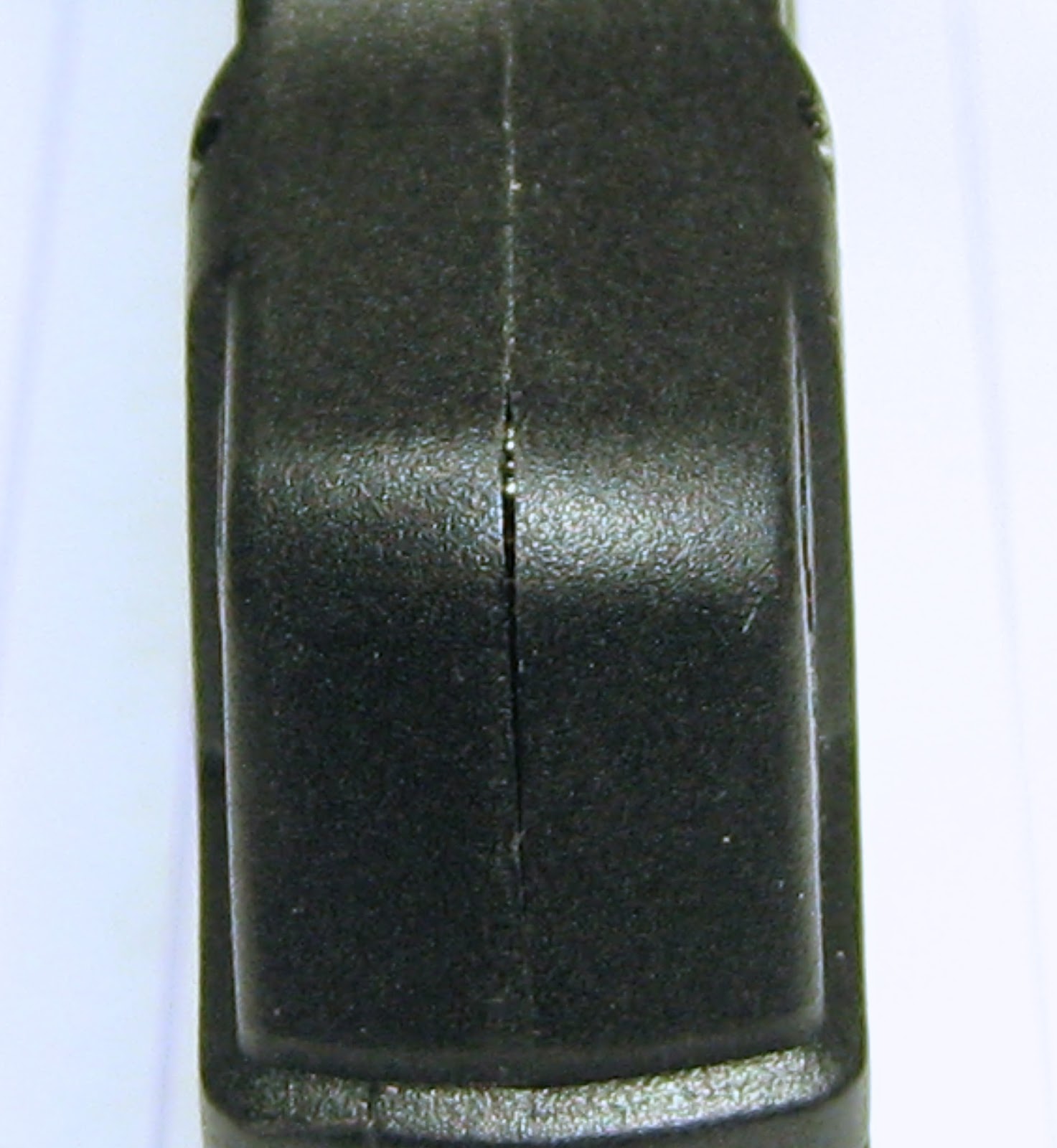
As you can see from the photographs below, I was unable to get the Defender's case to come completely together, even while forcing it by pinching it very hard while tightening the machine screws. I tightened the screws as much as I dared and still I could not get the gap to close. (See the photos below) I removed the Defender and checked for anything that might be keeping the sides from mating properly. The edges were both smooth and I could find nothing that might prevent the halves from closing. So, I tried another method.


The Defender gap


Defender gap, end view
Grabbing couple of strong, spring clamps I use for model ship building, and attaching them, as you see below, I was able to get the gap pretty much closed while I tightened the machine screws again.


The solution. Clamp the ends while installing and tightening the screws.


I was able to get most of the gap closed, but there still remained a small opening at the end of the sight casing. I suspect this is a molding problem resulting from not having exactly flat and true mating surfaces on the two parts. If I were to keep this particular unit on my gun, I would find some plastic filler and fill in that gap to keep it water tight. Of course, this would make it more difficult to remove and replace batteries, for example. You'd have to re-seal it each time.


After clamping

Below, showing the uneven mating surfaces on the Defender, and the position of the push-button activation switch. It is set into a small cavity cast into the sides of each casing to prevent accidental activation in a holster, for example.
Defender activation switch

As a comparison of the end mating surfaces, below is a photograph of the LaserMax CenterFire unit on the LCP showing a clean and precise mating surface.


LaserMax CenterFire end view


One of the biggest issues laser sight makers have in selling to people who are interested in trying them for their carry guns is that of holsters.
If a person buys a gun with a laser attached, or is getting an aftermarket laser for a new gun for which he or she has no, or few, holsters, this is not so much of a conundrum. However, most of us have a few carry guns already, and more than one holster for each. I have too many holsters for my guns, and from what I read, I am not unusual in this. Hickok45 even did an entire episode devoted to the holsters in his 'holster box'. I'm not that far gone, but I'm not that far behind either.

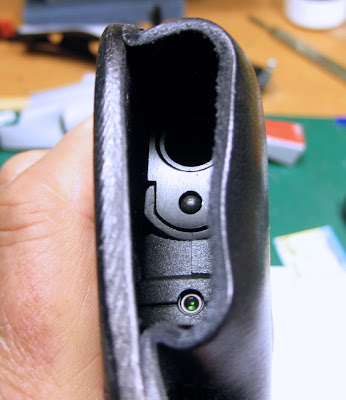
So, I think it is proper to include the holster question, briefly, in this comparison. I venture the opinion that if one already has a holster that will fit a LaserMax equipped handgun, getting a Defender equipped gun - the same gun, of course - to fit that holster depends on the holster. A holster made from heavy leather, like this Bear Creek pocket holster below, would not work. It would be almost impossible to re-mold this kind of holster to fit anything but what it was designed for. I've put the Defender-equipped LCP into this holster to illustrate the point.

Defender equipped LCP in a Bear Creek holster moulded for the Crimson Trace Laserguard

However, a holster, like this Remora with attached magazine pouch, will easily accommodate the LaserMax Centerfire, and the Crimson Trace Defender, and the LaserGuard for that matter.

Defender equipped LCP in a Remora holster. This holster will accommodate all three lasers, the LaserMax Centerfire, the Crimson Trace Laserguard and Defender.

I favor back pocket carry for the LCP, when I go that style, and the Uncle George is my choice for a great holster. It's 'heavy' enough to securely hold the pistol and prevent printing, but 'light' enough to easily draw from while it is in the pocket, and the leather can be somewhat re-molded to fit a slightly differently sized and shaped laser.  Following the directions on Uncle George' website, I used a hair dryer to heat and re-mould this holster to fit the LaserMax Centerfire even though it was originally made for the Crimson Trace LaserGuard. However, trying it with the Defender shows me that the Defender is just too bulky to re-mold for it.


Uncle George back pocket holster made for the Crimson Trace LaserGuard, which has been slightly re-moulded to fit the LaserMax CenterFire sight. The Defender, shown here,  is too large for the holster

Another view of the Defender in an Uncle George.

Last, I put the Defender equipped LCP in my Hay's cross draw holster. It's not in there all the way and it would probably work, but that would not be up to the standards I require in a self-defense holster.


A Hays cross draw holster, made for the LCP/CT LaserGuard combination. If the stitching were not in place at the bottom, this holster might be made to accommodate the Defender, but as is, it's slightly too small.


So, the conclusion is that if one has a holster made for a laser gun already, even a Crimson Trace unit, the Defender might, or might not fit, or be made to fit. In my experience, a LaserMax CenterFire has a better chance of fitting into a holster made for the Crimson Trace LaserGuard, or vice versa, than does the Defender.

If you are in the market for either one of these sights, plan on also getting a quality holster for it. Both LaserMax and Crimson Trace can point you in the direction of good holster makers who make quality products for each.

Function
Well, where the rubber meets the road, or the bullet meets the target, is the end result of this exercise in laser sight aids.

Both companies have essentially the same laser units in their offerings, functionally speaking. Laser power is constrained to be no more than 5mW in power with a wavelength of 650nm (nano meters). Their beam shapes are identical and both emit in the red spectrum.

Once switched on, there is not much to choose from between the two. In low light or darkness they are bright and easy to see. Also under most lighting conditions, especially at expected self-defense distances, seven to ten yards, they are readily visible even in sunlight.

In general, my opinion is that it is not a good thing to become heavily dependent on a laser sight on a self defense handgun. There are times when it can be very useful and provide a distinct advantage, but there are also times when it's something else to operate and for the eye to pick up that red dot. Getting a shot off as quickly as possible may be critical in certain instances, and there would be no time for dot acquisition. Given that laser sights are another option in one's self defense repertoire, acquiring and training with a laser sight is a good thing. I especially think they are most valuable when coupled with a small gun, like the LCP which is difficult enough to shoot accurately in the first place.

I think the biggest factors separating the LaserMax CenterFire and the Crimson Trace Defender come down to quality of construction, integration with your chosen firearm and personal preference between the two actuating mechanisms. In my opinion, after using both, I think the LaserMax Centerfire is the best choice.

The quality of construction is demonstrably better than Crimson Trace's current effort with the Defender.

I don't care for the bulky shape of the Defender, preferring the smoother integration of the CenterFire with the LCP, but this is, of course, solely a matter of personal taste.

 Lastly, having spent a number of years as an engineering technician I am inherently suspicious of mechanisms with too many moving parts. The Defender's spring-loaded push-push switch is more likely to fail than the CenterFire's simple push on, push off switch. It probably won't happen, but Murphy has taught me that things do happen and they mostly happen at the worst times. Simply put, in the CenterFire's simple, springless on/off switch, there is no spring to fail.

I want to express my profound thanks to LaserMax and Crimson Trace for stepping up and providing these laser sights for a comparison evaluation. It has taken a number of months to get everything in place and I hope the result is worthwhile and helpful to anyone considering a laser sight for their self defense handguns. Both Crimson Trace and LaserMax are small companies dedicated to designing and producing quality products and their customer service and relationship management staffs have been helpful to me in this project.

Please leave any comments and I will respond as best I can to them.

Sunday, June 2, 2013

Lasermax Update!


I can begin this post with the assurance that Murphy is alive and well. As you probably know, Murphy's Law states that if anything possibly can go wrong, it will.

After moderating many pro and con laser sight discussions on the old Elsie Pea Forum, and being pretty much on the fence myself, I concocted the idea that if I could get samples of the different, popular laser sights for a handgun, I could evaluate them, test out their usefulness for me and report on what I found. I got a Crimson Trace laserguard pretty quickly. The Laserlyte people promised a sample, but then didn't come through or respond to my subsequent emails. The Lasermax folks were cooperative and got me to the right person to set this up. Then, things fell between the cracks.

After a few emails, I discovered that the original person handling these situations was no longer with the company, and her replacement made contact with me. She liked the idea and we began to discuss how the evaluation and review would be handled. Then more delays. I was getting frustrated with the lack of progress and posted about this here. Then, I re-established contact and we both discovered that Murphy had been at work.

The order meant to send the evaluation items to me had entered their provisioning system, then got canceled. No one knows why as yet, but they are checking into it. They obviously don't want that happening in their ordering and provisioning systems. Then, my contact in Public Relations discovered that my later emails were being directed into her junk mail folder. I wasn't the only one, it turned out. Other important contacts' emails were also being mistakenly routed to the junk mail folder. Strangely, this exact thing had happened to me on a day before. Sometimes, software is too smart for its own good.

Anyway, I think we are back on track. As I see it, this was one of those things that sometimes happens in business, and life, where a few things get off track due really to no one's fault. I should have some review items from Lasermax soon, and I can get my comparison study underweigh.

I want to thank Lasermax for being responsive and tracking down the issues that we experienced. I think one big lesson in all this is to work with other parties to resolve issues instead of jumping to conclusions and slamming people or companies without justification. It resolves around assumptions. Almost every time I've made an assumption about an issue and acted on it, without asking questions and trying to understand all of the facts and circumstances involved, I've made a mistake.

So, a big thank you to Lasermax for hanging on to good customer service like a dog on a bone. It's good to find a company that understands their customers are what keeps them in business.


Monday, May 20, 2013

Lasers: no light at the end of the tunnel

As I posted here earlier, I am trying to get a detailed comparison going with the major laser sight manufacturers. I'm a normal guy, or so some people have said. (Don't ask my kids.) I want to do a "normal" evaluation conducted over time by a representative civilian legal concealed carry person. That would be me.

Crimson Trace was the first to respond. They were quick and effective, sending me a unit for my Ruger LCP. Nice. LaserMax responded, and then the long, long saga began. Some of that is detailed here. Unfortunately, it is still going on. I've had numerous communications with LaserMax, both via email and phone. They are very nice and accommodating, but have somehow run into continuing difficulties in getting their promised units to me for evaluation.

I understand how issues come up in business. After all, I spent fifteen years in a giant corporation dealing with issues resolution on a daily basis. However, I was usually able to get the issues resolved, and to keep the effected people in touch with what progress was, or was not, being made. LaserMax is, I think, trying to resolve the issue with supporting my evaluation and review of their sights, but getting information from them is like the proverbial water from a stone. Not happening.

If I get no action this week, I will have to call off the laser sight review and evaluations. I'll do more postings about Crimson Trace, the sight and the company, but I may not be able to compare the plusses and minuses with LaserMax's products.

Oh, and Laserlyte.... they said, sure, we'd be glad to participate. Then I never heard another word.

Friday, April 12, 2013

A Few Facts About Carrying a Gun for Self Defense

There is a source available on the internet for facts concerning many important topics and issues. Gun Control is one of these. The source is Just Facts. This is a valuable and important source for all gun owners and self-defense carry people to know about and be familiar with because, in the current gun debate, facts are the best tools you can have.

What distinguishes this resource from many other internet "fact sources" is the site's care to be unbiased and to avoid skewed and inaccurate data.

In JustFacts introductory note they say:

"This research is based upon the most recent available data in 2010. Facts from earlier years are cited based upon availability and relevance, not to slant results by singling out specific years that are different from others. Likewise, data associated with the effects of gun control laws in various geographical areas represent random, demographically diverse places in which such data is available.

Many aspects of the gun control issue are best measured and sometimes can only be measured through surveys, but the accuracy of such surveys depends upon respondents providing truthful answers to questions that are sometimes controversial and potentially incriminating. Thus, Just Facts uses such data critically, citing the best-designed surveys we find, detailing their inner workings in our footnotes, and using the most cautious plausible interpretations of the results.

Particularly, when statistics are involved, the determination of what constitutes a credible fact (and what does not) can contain elements of personal subjectivity. It is our mission to minimize subjective information and to provide highly factual content. Therefore, we are taking the additional step of providing readers with four examples to illustrate the type of material that was excluded because it did not meet Just Facts'Standards of Credibility."

Justfacts.com is one research source I can rely upon to provide fact-based information from which I can draw my own conclusions. To that end, I present some interesting facts gleaned from their site relevant to those who carry for self defense, and also to those who oppose self-defense carry out of ignorance, or because they don't understand the, well... facts.

Number of gun owners in the US
According to private firearms manufacturers data in 2010, there are between 40 and 45 million adults who own handguns.

A 2005 Gallup poll indicates there are 100 million adults who own guns of different types. In the same poll, 67% said they owned guns for self protection.

Why is having a gun for self protection necessary?
Some facts (from the Justfacts.com website. See the site for additional references and support for the information listed below.):

  1. A 1993 nationwide survey of 4,977 households found that over the previous five years, at least 0.5% of households had members who had used a gun for defense during a situation in which they thought someone "almost certainly would have been killed" if they "had not used a gun for protection." Applied to the U.S. population, this amounts to 162,000 such incidents per year. This figure excludes all "military service, police work, or work as a security guard." 
  2. Based on survey data from the U.S. Department of Justice, roughly 5,340,000 violent crimes were committed in the United States during 2008. These include simple/aggravated assaults, robberies, sexual assaults, rapes, and murders. Of these, about 436,000 or 8% were committed by offenders visibly armed with a gun.
  3. Based on survey data from a 2000 study published in the Journal of Quantitative CriminologyU.S. civilians use guns to defend themselves and others from crime at least 989,883 times per year.
  4. A 1993 nationwide survey of 4,977 households found that over the previous five years, at least 3.5% of households had members who had used a gun "for self-protection or for the protection of property at home, work, or elsewhere." Applied to the U.S. population, this amounts to 1,029,615 such incidents per year. This figure excludes all "military service, police work, or work as a security guard."
  5. A 1994 survey conducted by the U.S. Centers for Disease Control and Prevention found that Americans use guns to frighten away intruders who are breaking into their homes about 498,000 times per year.
  6. A 1982 survey of male felons in 11 state prisons dispersed across the U.S. found:
  • • 34% had been "scared off, shot at, wounded, or captured by an armed victim"
  • • 40% had decided not to commit a crime because they "knew or believed that the victim was carrying a gun"
  • • 69% personally knew other criminals who had been "scared off, shot at, wounded, or captured by an armed victim"

The last, number 6, should be especially relevant to those who support self-defense carry.

Those are some facts pertaining to the usefulness of a gun in preventing violent crime. How vulnerable are we? Consider this:

 At the current homicide rate, roughly one in every 240 Americans will be murdered.

A U.S. Justice Department study based on crime data from 1974-1985 found:

• 42% of Americans will be the victim of a completed violent crime (assault, robbery, rape) in the course of their lives
• 83% of Americans will be the victim of an attempted or completed violent crime
• 52% of Americans will be the victim of an attempted or completed violent crime more than once

A 1997 survey of more than 18,000 prison inmates found that among those serving time for a violent crime, "30% of State offenders and 35% of Federal offenders carried a firearm when committing the crime."


Justfacts goes on to show interesting charts describing the effects of various anti-handgun legislation passed in different locations. You can see these yourself on their site, but the summary is that where anti-handgun legislation is passed that inhibits the citizens from owning and carrying a gun for self protection, the incident of violent crime increases. When those restrictions are struck down, not surprisingly, the incidents of violent crime perpetrated against citizens goes down. Not a big surprise to most of us.

Why this information is important.
In the continuing national debate over gun control, which I think should be about violence control, it is important to have a good grasp of the facts. Every time I have argued this issue with someone opposed to guns, I have found that they do not know the basic facts about guns and self protection. They are working from rhetoric, falsehoods and, in many cases, just plain fear of guns. 

My response is usually to point out that it is a free country, that they don't have to own or carry a gun, but in fact, they depend upon someone for their protection who does carry a gun when thing go bad. As they frequently do, facts tell us. And, given this, all law-abiding citizens of the United States have the right to keep and bear arms in self defense in order to assist us in our constitutional rights of life, liberty and the pursuit of happiness. And, conversely, no one has the right to prevent me from exercising those freedoms.

When the criminals and crazies can no longer have guns, or knives, or baseball bats, or screwdrivers, cars, explosives, ice picks, poisons or any other implement that can be turned into a deadly weapon, I might consider giving up my guns.

Not likely....

Thursday, November 29, 2012

Crimson Trace Replies

Fastest yet is Crimson Trace. I got a reply the next day from their Media Relations Manager with the news that they are sending a unit for evaluation. No questions or delays. That's what I call good customer service.

So, I'll soon have a Crimson Trace and a LaserMax for testing and evaluation. I will post first impressions here as they arrive, then plan on another more extensive evaluation that examines operation, effectiveness, concealment qualities, and so forth. For now, first impressions are that Crimson Trace and LaserMax are in the lead as far as customer service and response are concerned. Now, if LaserLyte decides which department will be reviewing my request, I might have good news from them too.

Eventually.

Reviews, Evaluations and Customer Satisfaction

Many of the items I review here are provided by their makers for that purpose. Not all. Some I have bought courtesy of my credit card. After doing this for a while I have formed a few opinions of the way in which companies approach review requests. First, I am obviously not representative of a large publishing concern with a huge readership. I do have a fairly steady readership and have had almost ten thousand visits since I started this blog. However, I do concentrate on a specific area - concealed carry - and attempt to be rational and as objective as a gun-toting Second Amendment supporter can be. As you will have noticed, I try hard to keep politics out of the discussion. I find that when politics and guns are mixed, any chance for rational discourse goes rapidly out the window.

Back when I was a moderator of the old Elsie Pea Forum (RIP), I saw and got involved in many discussions concerning the use and value of laser sights mounted to concealed carry handguns. Now, being of the old school and having had my training and qualifications with a handgun courtesy of the U.S. Marines and an old Model 1911 pistol, I'm not one to favor laser sights right off the bat. It became quickly evident that many of those who had these gizmos attached to their pistols really liked them. More so, many gun makers provide some of their handguns with laser sights installed at the factory. Even so, many members of the forum lined up against them and their reasons were many but the most often cited were: dependence on another piece of gear that might fail at the wrong time; turning it on; trying to find the red dot instead of sighting on the target. The laser supporters answered these in various ways but it became apparent to me that I could not be an effective part of the conversations since I have no experience with this technology applied to handguns. And, furthermore, I was unlikely to do so since they are expensive and if I did want to equip and carry them on my self defense guns, I was looking at a considerable cash outlay for the sights and the new holsters I would need. So, I passed.

However, having re-thought this, I decided that if I could get some real-world experience with various laser sights on at least one of my carry pistols, I could do a thorough evaluation from a "normal" (yeah, I know...) person who legally carries a handgun for self defense. I don't have a bias, one way or the other, nor do I support any firearms related companies or have any interest in supporting one company or maker over another. I am basically interested in reporting, from my personal perspective, what works for me as part of my concealed carry systems and training and what doesn't. In this spirit, I contacted three manufacturers of laser sights for handguns asking for an evaluation unit that I could test and report on here. I also stated that I would return the unit to them after the testing and evaluation was done. This seems like a reasonable request. I get to find out about their products, test them, report here and send them back. They are out postage and some free publicity on my blog. Of course, the publicity could be good or bad or both.

Although I have not received any product to test as yet, the two responses I have gotten are interesting.

The first company to respond was LaserLyte. They were quick to reply to my query but vague about whether or not they wanted to participate. The person who responded to me is "forwarding my request to the proper department for review". Wow. Departments. I guess they are trying to figure out which of their departments should handle this request. I'm not too thrilled by this or what it portends for me actually getting a unit to test. I am certain that I am not the first person to ask for a review unit - there have been a bunch of reviews done to date already - so why would they have to find the proper department to review my simple request. It is possible that this is a stalling tactic, or perhaps this is just procedure, how they handle unknown people out there in cyberspace who are asking them for something. I don't know. That happened on November 21. It is now November 29, eight days later so either they have a great many departments, a great many requests of this nature, or my email is sitting on the bottom of a virtual pile of emails somewhere in the proper department.

The second company to respond was LaserMax. My request went to them on November 21 and someone responded to me on November 26. It was short and sweet. Yes, they have evaluation units and will send one to me. That was good and it was customer friendly and pretty darn quick. I'll let you all know when it arrives.

The third company I contacted was Crimson Trace. I sent an email to them yesterday. I thought I had sent a contact form at the same time as I had contacted Laserlyte and LaserMax, but I don't think I did that, so I sent one (or another) yesterday. I also was in contact with a friend who is a holster maker who told me that when the Crimson Trace became available for the handguns for which he made holsters, he contacted them and requested an empty shell that he could use to make holsters for guns with their sight attached. He needed something to fill orders until the blue gun makers released moulds of guns with Crimson Trace lasers for holster makers. He sent them his web site URL and tax number and the necessary information to prove he runs an actual business. They said, sure, he could buy one from them at a discount, but were not willing to provide even the empty shell. This is not very good customer service in my view. Who knows? Crimson Trace may have adopted a more customer satisfaction friendly policy in the interim. When I get a reply from them, I will post the results here.

So, laser sights. There it is. I will test and evaluate whatever unit, or units, I can get from the makers and report my findings and personal opinions here. As this little project gets going, it is obvious that part of the reporting will include how the companies handle requests, queries and issues from their customers. For me, the attitudes and practices of companies making products plays an important part in whether I will spend my money on their goods, or look elsewhere for a similar product with good support and service.

Friday, September 21, 2012

Holster Evaluation Results

Bear Creek's IWB for the LCP
A Damn Good Holster


I have a number of holsters primarily for concealed carry, and I have tried a few more than that. A few I have kept for a while, carrying them in various situations, dress and weather, evaluating which ones work the best for me. My goal is to arrive at two or three holsters that I carry in one or two positions so that I limit the possibilities for confusion should I need to react in a self-defense scenario.

All well and good, but it became obvious that I needed some method to my madness or I would be relying on memory and fading impressions, both of which are increasingly unreliable. So, I developed a simple chart with which to record and analyze my simple requirements. You will see that below. At the time I began keeping these records, I owned a Ruger LC9 along with the other two Rugers in the chart. I've since put the LC9 up for sale since I believe it is redundant to the SR9c which has many advantages over the somewhat smaller LC9. Regardless, I did collect data about that gun which is shown below.

The chart below is grouped by gun, then by score. A higher score is better than a lower one. I generally took the range from 1 (worst) to 5 (best). These are obviously subjective and relate to my preferences, habits and body type. Meanings of the rating categories:

Secure: Does the gun and holster stay where I put it, throughout a carry period. This usually involved sitting, standing, walking, some short running, kneeling, bending, and the normal activities you'd be engaged in throughout the day. I want a holstered gun to stay where I want it to be throughout my day. Period. This is a problem for IWB holsters unless comfort is sacrificed.

Comfort: Speaks for itself. If the rig is comfortable, I'll carry it readily and for long periods. Otherwise, it ends up in the drawer or on eBay. I don't have to "forget it is there". In fact, I want to know it is there, where it is and that it is not bugging me endlessly.

Cover: Do normal garmets cover the holster and gun in normal, everyday activities, or do I have to continually adjust for either comfort or, worse, concealment. This is also a major issue with most IWB holsters. It is closely associated with the "Secure" category, above. First, if the holster and gun can be worn comfortably in a way that conceals under normal garb, then, will it stay there. If it prints anywhere you put it on, then it fails this test obviously. If it swivels, rotates, shifts or otherwise moves into a place where it prints, this is a failure of a holster allegedly made for concealment.

T-Shirt: I wear T-shirts frequently in the spring and summer, so any IWB (and some OWB) holsters that are made to conceal will have to do so under a T-shirt. Around here, when fall really comes in, we can count on putting the T-shirts away until late spring, so this is a requirement that might be met with a 'summer' holster that works particularly well with T-shirts.

Final Notes
A category that doesn't appear in the charts but is assumed to be there for any self-defense holster is ease of draw. If the thing is hard to draw from, it's going back to the maker with a note, or in the trash.

The Bear Creek IWB holster pictured above was one of my first LCP holsters. It served me well and long. I sold it to a friend who was getting started with concealed carry. If I had it to do again, I'd keep it, and have Doug make one for him.

I currently have a new D.M. Bullard OWB cross draw holster made for the SR9c. I have been using and testing it for a few weeks - thanks to Dave for the opportunity. It is not rated in the charts. As I have noted in previous posts here, while the quality is outstanding, the combination of my body type and the size and heft of the SR9c contributes to the holster not pulling the butt of the gun in close enough to my torso. Regardless of where I position it, and I wear a heavy gun belt made by Doug Childers of Bear Creek Holsters, there is always a one to two inch gap between the gun butt and me, which produces printing under anything other than a jacket. I am still working with the holster and will have a more detailed final review here later.

Update: Since this was originally posted I have experienced and issue carrying the Ruger SR9c and a Versacarry in the cross draw position. When bending down sharply to pick something off the floor, the magazine button on my SR9c was depressed and the magazine ejected onto the floor. Caution is advised if you use a Ruger SR9 or 40 series semiauto with a Versacarry holster in the cross draw or appendix carry position. More information will be posted when I get feedback from Versacarry.


Holster
Type
Gun
Rating
Secure
Comfort
Cover?
T-Shirt
Comments
Bullard Bodyguard
OWB
LC9
17
5
4
4
4
Comfortable. Secure. Hides well. Draws well.
Remora
IWB
LC9
14
3
3
4
4
Versatile. Ambidextrous. Moves from position depending on your activities.
Versacarry
IWB
LC9
14
3
3
4
4
Minimal. Trigger open on one side. Inexpensive. More comfortable than it appears.
pjholster
IWB
LC9
12
3
1
4
4
Excellent quality. Light. Hard. Not comfortable in appendix or cross draw positions.
Remora Tuckable
IWB
LC9
12
3
3
4
2
Versatile. Ambidextrous. Moves from position depending on your activities.
Fobus
OWB
LC9
9
3
4
1
1
Paddle can be insecure. Minimal concealment. Requires cover.
Uncle George
Pocket
LCP
20
5
5
5
5
Quality. Ease of carry. Very concealable.
Galco Stow-n-Go
IWB
LCP
19
5
4
5
5
Inexpensive, well made, excellent clip, comfortable.
Nemesis
Pocket
LCP
19
5
4
5
5
Quality. Ease of carry, problematic access in front pocket.
Bullard Bodyguard
OWB
LCP
18
5
5
4
4
Comfortable. Secure. Hides well. Draws well. Very high quality.
Versacarry
IWB
LCP
18
4
4
5
5
Minimal. Trigger open on one side. Inexpensive. Very comfortable in this smaller size.
Remora
IWB
LCP
16
3
4
5
4

Bullard Bandit
OWB
SR9c
17
5
5
4
3
Comfortable. Secure. Needs cover. Draws well. Very high quality.
N82
IWB
SR9c
15
3
4
4
4
Comfort. Secure. Adjustable cant. Large.
Supertuck
IWB
SR9c
15
4
3
4
4
Big. Wide. Difficult clips. Better for bigger person.
Versacarry
IWB
SR9c
14
4
3
4
3
Minimal. Fragile. Trigger open on one side. Cheap
Remora
IWB
SR9c
12
3
3
3
3
Versatile. Ambidextrous. Moves from position.
Remora Tuckable
IWB
SR9c
11
3
3
4
1
Versatile. Ambidextrous. Moves from position.


Comments
Versacarry
IWB
May break at clip hinge if over stressed. Trigger guard covered on one side only. Surprisingly comfortable.
pjholster
IWB
Hard, inflexible, and comfort depends on position.
Bullard Bodyguard & Bandit
OWB
 Conceals surprisingly well with a loose T-shirt, but not perfectly. Comfortable. Secure. Needs cover. Draws well. Very high quality.
Remora
IWB
Basic holster. No reinforcement or sweat shield. All Remoras may shift position a small amount or significantly depending on where they are placed, and the activities engaged in. Some locations are more secure than others. For larger guns, between the belt and waistband is most secure. The tuckable versions work well with the same caveats as above.
Uncle George Holster
Back Pocket
The almost perfect pocket carry. Always in position. Light and flexible enough to be very comfortable, heavy enough to protect the LCP. Easy to draw. Conformed so you sit on the end of the panel, not the pistol.
N82 Tactical Pro
IWB
A good solution to concealment and comfort, with a couple of design flaws. Comfort is outstanding especially for the larger guns. Protection of the pistol is also excellent. The single clip means easy on and off, but permits the holster and gun to move, swivel and change position which may produce some printing. The gun is held in place by a designed "lip" cast in the plastic over the trigger guard which requires a slight inward twisting motion to release the gun on the draw. Something else to remember which adds a complicating factor in what may be a stressful situation.
Crossbreed Supertuck 
IWB
Wide leather base, kydex holster with dual clips which can be difficult to engage. Adjustable in cant and ride height. Not as comfortable as the N82 Tactical, but more stable. Expensive.
Galco Stow-n-Go
IWB
An outstanding solution to a comfortable, effective and inexpensive IWB carry for small pistols. May work as well with larger handguns. And, it is inexpensive with one of the best clips on the market.