About SD Carry

As a young boy in Texas, I grew up with guns. They were basic tools, much like my grandfather's mitre box or pipe wrench, there to perform specific tasks when called upon. I was taught gun safety by virtually every male adult in my family. I spent eight years in the US Navy operating and maintaing various guns from .30 caliber to 5" rifles.

After a few years as a moderator on a popular gun forum, I learned that there is much disinformation, prejudice and plain ignorance about guns posted constantly on the internet.

This blog is dedicated to sharing worthwhile information about the increasing acceptance and practice of legal concealed carry in our country. There is much mis-information and wild opinion about this topic among its practitioners and the public in general. The moral, social and legal responsibilities of concealed carry are immense and must be understood and practiced by all who legally carry a gun.

There is also a vast amount of practical and useful information about carrying and the weapons themselves and I hope to be able to share some of that here. Your comments are welcome, but will be moderated by me before appearing on this blog.

Stay safe.

Other Pages

Showing posts with label lasers. Show all posts

Tuesday, August 18, 2015

Another Lesson Learned

Sunday I went out with a good friend to get in some shooting – target practice, a bit of training and fun. It turned out to be a learning experience for me as well as a fun afternoon. What did I learn? Well, that I cannot shoot a Ruger LCP well enough to justify keeping it as a self defense gun. Now, I love the Ruger LCP. I've had the older model, and, later bought this one, the newer model with the improved trigger. I have shot a good number of rounds through the LCP platform, but this weekend, I learned that I can't shoot it accurately enough.

This is not a gun problem. This is a shooter's problem. My problem, and not necessarily yours or anyone else's problem. I spent a few years moderating a gun forum that had quite a number of LCP owners and entusiasts as members. I'm certain that many people can perform up to expectations with their small .380 handgun, but my experience has been different.

What happened was this. I have a new LaserMax CenterFire sight on the pistol. I believe firmly that on small, self defense handguns, a laser is a necessary accessory. Most bad things happen in the dark, or darkness, and a laser can help ensure one hits what is being aimed at, especially with a gun like the LCP which has minimal sights to begin with. I fired some close range, steady rounds to ensure the alignment of the laser was correct, then moved to a steel target set up about chest high, and about chest size. Drawing and firing the first magazine at ten yards was enlightening. I shot more plants and dirt than steel, even with the pulsating red dot to aid my aim.

Not good. Reload. Shoot without the laser, still quickly, although slower than one would take in a real crisis situation. Six shots. Two hits. Again. Same speed but closer. Two hits again. Moved to about five yards and repeat. Better, but only 50% hits. Even with more attempts it didn't get any better.

If I had to place the errors anywhere it would have to be with two things, the very small form factor of the gun, coupled with a difficult and long trigger pull.

The short barrel, light weight and two-finger grip necessary on this pistol require the shooter to have an exceptionally steady hand, especially when pulling the trigger. Any slight variation will move the barrel way off target. Unfortunately, even with Ruger's improved trigger on this newer LCP, the effort and distance required to pull through to the break point is too great to maintain acceptable accuracy for me.

The LCP generates a significant amount of recoil which, coupled with the light weight of the pistol, jerks it off target with each shot so one must be very deliberate getting it back on target and trying to make a smooth trigger pull for the next round. Frankly, this was very difficult for me.

During the afternoon, I fired many rounds through the M&P Shield 9mm, an M&P 40, and a .38 special airweight, all with acceptable accuracy in slow and rapid fire. Not marksmanship competition accuracy, but with good "stopt the threat" accuracy.

Why do I have an LCP in the first place? It is small, very small, light weight, easily concealable and comfortable to carry all day, and it is effective with the modern self defense loads. All this is good, but not worth anything if the gun can not be used effectively and responsibly. For me, it's not effective, and perhaps more importantly, not responsible since I do not want to ever endanger innocent people by not being able to shoot at and hit the threat and nothing else.

I can not justify keeping the LCP for those two reasons. I will sell it and point the buyer to this article, so that he or she will understand the limitations and advantages of the pistol.

I encourage you to evaluate your carry arms for their effectiveness and responsibility when being used by you. You might be in for a surprise.

I certainly was.

Monday, July 27, 2015

A New Carry Gun, A New Laser

New CenterFire Laser from LaserMax
A few months ago I replaced my original Ruger LCP with one of their new models having the improved trigger and sights. The sights are still rudimentary and not useful for the intended purpose of this pistol, which is, concealed carry for up-close encounters. Although the LCP and its kin are often referred to as "point and shoot" guns, that moniker belies the fact that small, short barrel handguns are notoriously difficult to shoot with acceptable accuracy. We are not talking about bulls eyes or "driving tacks", but about hitting a 20" diameter circle at, say, five to fifteen yards, at the outside.

I've shot these small handguns a lot, and have helped and witnessed others to shoot and become familiar with them. They are not accurate in the hands of the ordinary person. Period. Standing at the range, wearing ear protectors, using two hands and sighting carefully, the average person who gets little to no practice can't hit a center-of-mass sized target more than two or three times out of seven shots. Take away the range environment and jack up the adrenaline, crank up the heart rate and the realization that someone close to you is about to do you bodily harm or death, and it just gets worse. Oh, and turn out the lights too.

I have reviewed laser sights and their advantages and disadvantages, which are few in comparison with the benefits they offer, elsewhere in this blog. See the links below. Here I would like to provide a brief update on the LaserMax CenterFire.

When I sold the old LCP, the laser went with it. Now, I'm a fair shot with my LCP but it quickly became obvious to me that I am a better one with a laser than without, so I acquired another CenterFire from LaserMax. (See below for my head-to-head laser comparison post.) I had it installed within  five minutes of opening the packaging. It is that easy. Mine required only slight tweaks in elevation and deflection to get the bright red dot exactly where I wanted it across the room and aligned with my iron sights.

The dot seems brighter to me than the one on my old laser, but I think they are the same power and wavelength. Perhaps the optics are a bit improved. I immediately liked the new switching arrangement: a "tap on", "tap off" switch that is easily accessed by my forefinger going right on top of it with the draw. If I want the laser on, a slight tap will do it. Tap again, and it is off. I developed the technique of just swiping my forefinger along the laser housing and protruding switch as I move it to the trigger. This automatically activates the laser.

Nice thing for me is that it doesn't activate unless I want it on.

Now, I'm back to my comfort zone for carrying small and concealed: the improved Ruger LCP and the improved LaserMax CenterFire.

Life is good.

See the links below for more information on my blog about lasers:

Laser Myths

Rail Mounted Micro Laser

Lasers: Pick your color

Dueling Lasers: LaserMax and Crimson Trace


Thursday, April 17, 2014

Laser Myths


As I noted on this blog earlier, there is a high bandwidth of ignorant and misinformed internet opinions available at the click of a mouse. They live among, and sometimes overwhelm, factual, rational and real information that would be helpful to the curious and the uninitiated. Gun forums are particularly prone to becoming a venue for unsupported opinion and basic misinformation. The interesting but unfortunate consequence of this is that many wrong, stupid, ignorant and sometimes hazardous opinions are accepted as fact.

In this post, I would like to offer some facts and reason to evaluate a common internet gun forum topic about which laser sight is "better", disregarding that "better" in this context is a very undefined attribute.

I have read many forum posts that go back and forth about which laser sight is "better": the LaserMax CenterFire or the Crimson Trace Laserguard. Mostly, the comments center on perceived notions of size, shape, beam and actuation preferences. Price usually doesn't come up, although the CT (Crimson Trace) is much more costly than the LM (LaserMax).It seems to me that the purpose of a laser sight on a handgun is to provide a highly visible aiming point on the same plane as the target when one wishes to fire a shot. This is especially important under low light conditions and with small handguns that are difficult to shoot accurately. All laser sights will do this with the same focal precision and power. The amount of power a laser sight maker can supply to the device is restricted. 

Looking at the LaserMax and the Crimson Trace models that attach to the underside of the frame, their size, weight and profiles are close enough to not make a real difference. I have used both and can vouch for this fact. Arguments about one being "slimmer" than the other are nonsense in any meaningful sense.


The main difference between the LaserMax CenterFire and the Crimson Trace Laserguard, disregarding cost, is the method of operation. With the LM you have a choice; with the CT, you don't.

The CT laser, given a firm grip on the pistol, is always on regardless of whether you want it on or not. I don't like technology that tries to do my thinking for me. I suspect that many people don't want to have to think about this so they go for the default "on" state. This indicates a lack of training on their part and their not understanding that the only time you need or want a laser shining from your gun is when you need to shoot.

Anybody can grab a CT equipped handgun and turn on the laser. Doesn't matter if they know what they are doing or not, whether their finger is on the trigger when they draw or not. As long as they hold the pistol with a firm grip, the CT laser is always shining. To disengage it, one has to modify the grip. Not a particularly optimal choice.

Additionally, I've noticed that with small guns like the LCP, where there are two fingers on the grip, depending on the shooter's hand size, the CT doesn't always stay on under rapid fire when the fingers may shift a bit under the recoil and mental pressure. If you are focused on the red dot and it suddenly disappears, you can be distracted and that next round may end up somewhere you didn't want it to go. Yes, if you can maintain a consistent hold and grip pressure during a self-defense shooting episode, this probably won't happen. But I submit that most people won't be that aware and precise.

Which leads to the fact that with the LM, the shooter always has the choice of the laser being on, or off. Whichever, it's not going to change from that state unexpectedly. 
You will see many posts about this by people who haven't bothered to learn and train sufficiently for defensive shooting. Think about it. 

If someone is set to quickly grab their gun and begin banging off shots with the laser on, I think this shows a lack of basic training on safe gun handling and shooting. When we train to operate defensively, we train to quickly and consistently draw our weapon from the holster, and position, of our choosing, in such a manner as to not shoot ourselves or an innocent bystander in the process. Proper grip. Trigger finger extended alongside the slide or trigger guard (varies with gun model of course). Extract gun and rotate clear of the body, pointing down range toward the target area. Finger extended, not on the trigger. Threat identification. Decision to shoot or not. If yes, finger goes to trigger as the weapon is centered on the target. Fire.

In the above scenario the only time the laser needs to be on is when you decide to shoot. If you are doing things right, the CT comes on when you grip the pistol in the holster. The LM does not. Why? Because you haven't turned it on. When can you turn it on? Whenever you choose because, if you are doing this right, as your gun clears the holster, your trigger finger will be resting on the LM slide switch. When your finger sweeps back to the trigger - whenever you decide to fire - the slide switch gets pushed in and the laser goes on as your finger slides into the trigger guard. Or, you may decide not to shoot but to actuate the laser anyway. Push the switch and it's on. Enough? Push the switch to turn it off. 

It is easy and natural to push the slide switch off with the thumb on your supporting hand to disengage the laser. Then, your trigger finger will automatically (it should!) be extended and again resting naturally on the LM slide switch where it all began.

With the CT, you are shining that laser beam around all the time, whether you have decided to shoot or not, unless you relax the grip on your weapon. And, if you are drawing, presenting and aiming correctly with a CT equipped gun, your trigger finger will be extended alongside the weapon, just like in the LM example, until you make the conscious decision to shoot. However, there won't be a switch under your finger because your laser will always be on, regardless of whether you want it on or not.

I've gone into some detail about this because this is a serious matter and deserves a serious and detailed examination, not off-hand remarks.

Statistics will show that the idea that all or most deadly force self defense shooting encounters are not of the split-second grab and shoot as fast as possible kind. Many encounters don't involve shooting at all, but the presentation of a deadly threat -  your weapon -  to a potential criminal perpetrator. Just the sight of your handgun may be enough to defuse the threat. Or that and the purposeful switching on of a little red dot on the middle of his chest. The fact remains, that if the person legally carrying is sufficiently trained to handle his or her weapon correctly, that person will be in charge of when and if the laser sight needs to be actuated and can do so as effectively and quickly with a LM as with a CT. But, with the LM, you get to be in control and make the decisions.

Simply put, if a person is trained to properly grasp, present, aim and fire a handgun in a self defense scenario, one is, by that very fact, trained to be in control of a LaserMax sight.

Saturday, October 19, 2013

LaserMax Micro, Rail-Mounted Laser Sight

The LaserMax Micro

This is a really slick, rail-mounted laser made to fit any pistol with a rail, but especially meant for small, compact semi-automatics. Many people are buying and carrying the "compact" guns for self defense. It is an unfortunate fact that many of those, especially newcomers to concealed carry, do not have the opportunity or time for the level of training they need. Time at the range and some simple self-defense safety, drawing and firing practice are all that many people get.

Shooting a pistol accurately is not easy even for those of us who shoot and train regularly. This is especially true when the chips are down, adrenaline is pumping and one is involved in a life-or-death situation. It is also a factor when one is forced to fire a pistol in low light, or dark situations. These are the times when many self-defense shootings occur.


It is incumbent on all who carry legally to be as safe with their firearm as possible, especially when innocent bystanders are around. This means you must be able to actually hit what you are aiming to hit. Aiming a pistol properly with iron sights is difficult at the best of times. At the worst, it pays to have as much help as you can get. That's where laser sights come in.


LaserMax has been making laser sighting devices for many years. Handgun sights are only part of their business and expertise. Recognizing the need to provide a very small, lightweight, reasonably priced, and easily installed laser sight for compact semi-autos with rail mounts, they have produced the Micro. LaserMax was kind enough to provide one for me to evaluate on my Ruger SR9c, one of my favorite 'compact' carry pistols.

I was not interested in a larger, under the slide type of laser sight for this gun. It is more an issue of esthetics with me. I like the way the SR9c is designed and I like the holsters I had carefully chosen for it, since it is one of my main carry guns. The Micro promised to be more unobtrusive, lighter and would fit one of my Remora holsters that I use for this gun. I received it in the packaging you see above, opened the wrapping and within about a minute had it on the pistol.


It looks like an add-on, which it is. It's much smaller and less bulky than the CenterFire or Laserguard models. Which is good. Still, it initially looked kind of weird, hanging under the muzzle like that.


View of the Micro mounted to the SR9c from underneath.

Looked at from the bottom, it is not much larger than the slide and under-barrel body of the Ruger. Nice.


Installation was pretty bomb proof, even for me. Slide it on the rail, line up the hole in the laser mount with the notch in the rail, insert screw. Tighten. Done.

Switch Protection


In the photos above, I'm showing a really thoughtful feature that should be more advertised for this sight. I was concerned about activating the laser in my holster and imposing unnecessary battery drain. Looking closely at the laser body and fitting it in my holster revealed what I term a switch protection shield. These protrusions extend on both sides only enough to stop the activation switches from contacting the holster. A very nice touch.


On the gun.
The photos below show how the Micro looks close up, mounted on the pistol, ready to go.


It is barely wider than the frame, and from the top, you can't see it.

In operation it's pretty simple. When I draw the pistol my trigger finger is naturally laying extended down the side of the frame. The tip of that finger touches the activation switch on the right side (remember, it has a twin on the left side for left-hand shooters, or in case you might be forced to shoot with your non-dominant hand) and to turn the laser on takes only a brief press with that fingertip. Another press, and it turns off.

The laser offers pulsing or constant beam. I prefer constant, but the option is there should you want to switch.

Carrying the Micro-equipped pistol
One of my pet peeves with lasers is the fact that getting one after having a favorite gun, and going through the pain and expense of finding a couple of good, safe, comfortable carry holsters forces one to adapt one of those holsters, if possible, or buy at least one more holster. There are a number of good holster makers, Cleveland Holsters, for example, that make outstanding holsters for Micro equipped handguns. I've discovered that my "standard" non-laser Remora holster was easily modified to accept the Micro, by removing a short row of strategically placed stitches near the bottom of the holster. That's what I'm using to carry the SR9c when the laser is aboard. I sometimes remove it and carry the pistol in a favorite, leather OWB holster. It is easy enough to do. It would be easier, if LaserMax would develop a quick change mechanism similar to that found on road bicycle wheel mounts. 

I have grown used to the sight on the gun. As I said, it is small. Very small. Unobtrusive. Doesn't get in the way and these days, it is usually mounted to the Ruger because it's just too damn important to leave at home alone.

Check these out for more information on the LaserMax site: http://lasermax.com

Be safe.

Friday, August 2, 2013

Dueling Lasers: LaserMax & Crimson Trace


My first comparison and evaluation is of the LaserMax Centerfire and the Crimson Trace Defender, both solidly in a competing marketplace for the popular Ruger LCP .380 pistol. Crimson Trace has long offered one of their 'regular' grip-actuated LaserGuard units for the LCP, and have recently introduced their new Defender series. This product is priced and designed as a direct competitor to LaserMax's Centerfire sight. Both companies have kindly supplied one of each unit for the LCP for this evaluation and comparison.
LaserMax

Crimson Trace
You will notice that the form factors are similar, though different in important ways. The shooter actuates the laser with the index finger, which should be positioned over the switch on either laser unit if the draw is done properly and good gun handling is exercised.


LaserMax CenterFire actuation position


Defender actuation position


As the photos show, the switches on both laser units are designed to be used either right or left handed, which is good in general, and shows foresight by both companies to accommodate situations in which the shooter's normal gun hand is occupied or incapacitated. The difference between the two designs, LaserMax and Crimson Trace, is in the actuation - a two way push-switch that remains in it's position once placed there, and the spring-loaded push on/push off switch Crimson Trace uses.

Press the LaserMax activation button, which is the end of the switch that protrudes from either side of the sight, with either index finer (or any other you might need to use) and it switches the laser unit on. The switch remains in the closed position, powering the laser, until the shooter turns it off by pressing the switch rod from the other side. Easy enough to do with a two-hand grip. Simply use a finger on the other, supporting hand.

The Defender relies on a spring loaded push button, actuated from either side. One push and the laser is on. Another push, from either side, and it's off.

The only operational disadvantage I see at this point is that it is possible to inadvertently push the Defender's switch a second time, turning it off accidentally. I don't see this a high risk issue, the switch being rather small and tucked out of the way in a long indent in the casing, but the possibility is there and should be recognized.


The Innards

Below is a photograph of the LaserMax CenterFire units, the one on the left is sized for the Ruger LC9, the one on the right is for the Ruger LCP. They are identical, but one is slightly larger to fit the larger LC9, but the components and arrangements are the same. The LaserMax units are joined with larger self-tapping screws. The allen wrench is supplied to perform any sight adjustments necessary.


LaserMax for the LC9 and LCP

 Below is a comparison shot of the circuits and actuation mechanisms of the Defender, on top, and the LaserMax below. The Defender's case is more bulky and slightly larger than the CenterFire due to the way in which the push button and laser circuitry are enclosed in their own case which is, in turn, enclosed by the overall case for the unit as a whole. The Defender requires two batteries and the CenterFire only one, but in terms of the volume necessary for either, that space is pretty much the same.
Defender and CenterFire internal components
A comparison of the two units, shown below, reveals that the Defender is somewhat larger in the forward portion of the sight than the LaserMax CenterFire, due, undoubtedly to the decision to combine the push button switch mechanism with the laser and it's circuitry into an integrated package.


CenterFire and Defender comparison.

Defender on top of the CenterFire

CenterFire end view showing the actuation rod protruding from both sides. Enough to work well, not enough to cause problems.

 Below are photos of the two unit's casings for a side by side comparison.


Defender and CenterFire external left side comparison

Defender and CenterFire internal left side comparison


How do they mount and look once attached to the pistol?
I would say that the aesthetics of the two designs is pretty much in the mind of the beholder. The LaserMax CenterFire more closely follows the smooth and flowing lines of the LCP, providing, to my eye, a more integrated appearance than the Crimson Trace Defender. It just seems more a part of the gun than an add-on accessory. Now, some may like the more bold look of the Defender, but, again, that's a personal preference. I think the proof is in the using since they are supposed to be sighting aids, not fashion accessories.


CenterFire on the gun


Defender on the gun


Installing the two units.
The installation for both are virtually the same, except the LaserMax uses phillips head self-tapping screws, where the Crimson Trace uses small diameter machine screws tightened by an allen wrench.

Install the batteries, or battery, snap the right side of the unit containing all the working parts to the trigger guard. Interlock the back strap into it's mate already now attached to the trigger guard, swing the left side of the case into place, mate up the halves, pinch them together and torque down the screws.

After doing this a number of times, I can remove the LaserMax Centerfire in less than a minute. I can attach it somewhat quicker. The Crimson Trace Defender, however, exhibited an issue with this relatively simple procedure.

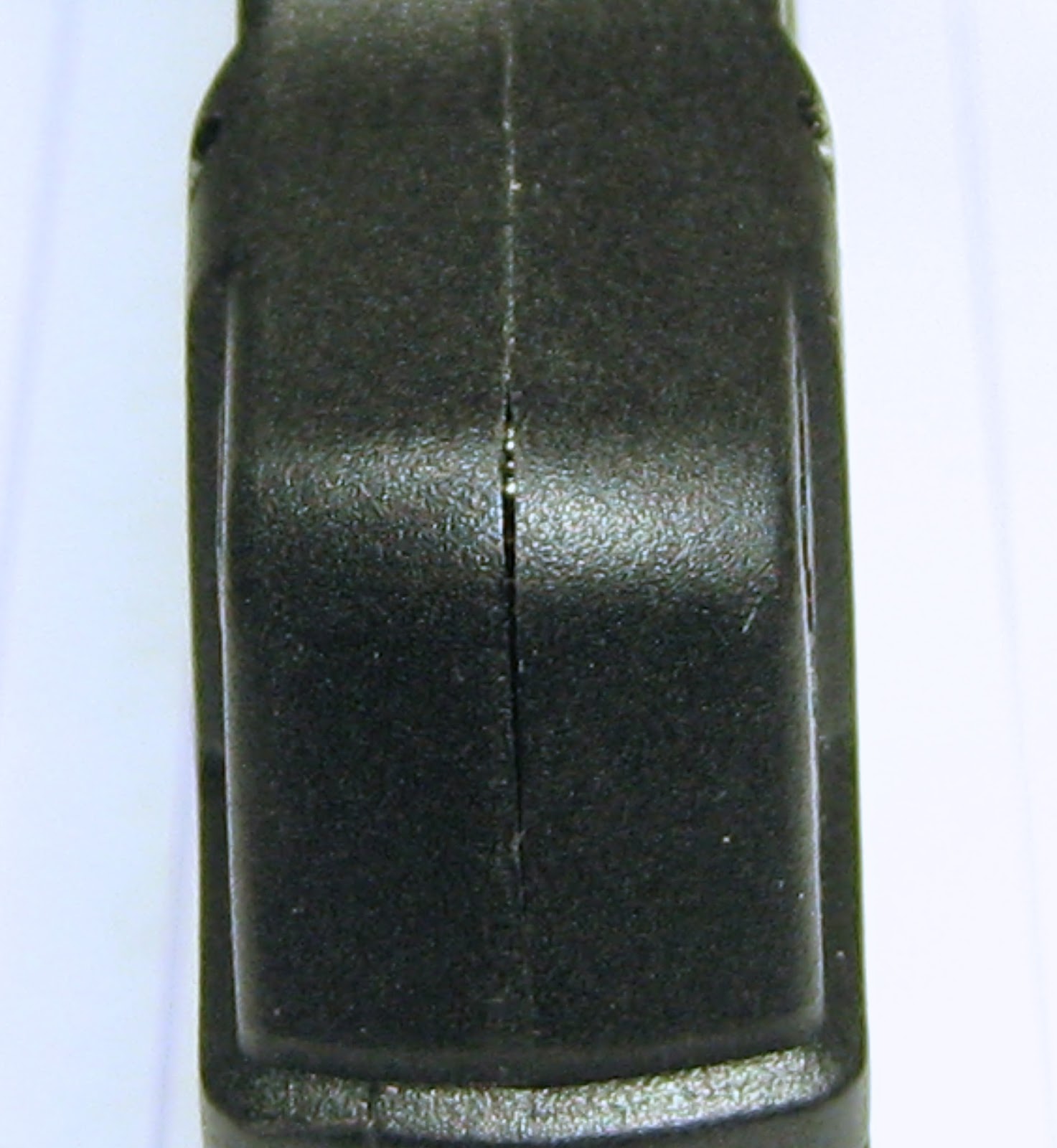
As you can see from the photographs below, I was unable to get the Defender's case to come completely together, even while forcing it by pinching it very hard while tightening the machine screws. I tightened the screws as much as I dared and still I could not get the gap to close. (See the photos below) I removed the Defender and checked for anything that might be keeping the sides from mating properly. The edges were both smooth and I could find nothing that might prevent the halves from closing. So, I tried another method.


The Defender gap


Defender gap, end view
Grabbing couple of strong, spring clamps I use for model ship building, and attaching them, as you see below, I was able to get the gap pretty much closed while I tightened the machine screws again.


The solution. Clamp the ends while installing and tightening the screws.


I was able to get most of the gap closed, but there still remained a small opening at the end of the sight casing. I suspect this is a molding problem resulting from not having exactly flat and true mating surfaces on the two parts. If I were to keep this particular unit on my gun, I would find some plastic filler and fill in that gap to keep it water tight. Of course, this would make it more difficult to remove and replace batteries, for example. You'd have to re-seal it each time.


After clamping

Below, showing the uneven mating surfaces on the Defender, and the position of the push-button activation switch. It is set into a small cavity cast into the sides of each casing to prevent accidental activation in a holster, for example.
Defender activation switch

As a comparison of the end mating surfaces, below is a photograph of the LaserMax CenterFire unit on the LCP showing a clean and precise mating surface.


LaserMax CenterFire end view


One of the biggest issues laser sight makers have in selling to people who are interested in trying them for their carry guns is that of holsters.
If a person buys a gun with a laser attached, or is getting an aftermarket laser for a new gun for which he or she has no, or few, holsters, this is not so much of a conundrum. However, most of us have a few carry guns already, and more than one holster for each. I have too many holsters for my guns, and from what I read, I am not unusual in this. Hickok45 even did an entire episode devoted to the holsters in his 'holster box'. I'm not that far gone, but I'm not that far behind either.

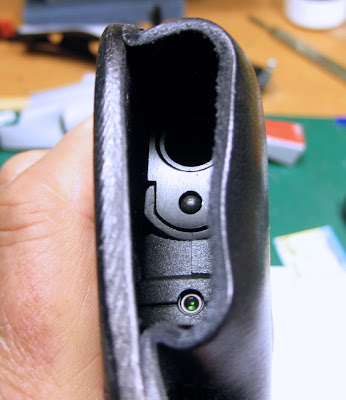
So, I think it is proper to include the holster question, briefly, in this comparison. I venture the opinion that if one already has a holster that will fit a LaserMax equipped handgun, getting a Defender equipped gun - the same gun, of course - to fit that holster depends on the holster. A holster made from heavy leather, like this Bear Creek pocket holster below, would not work. It would be almost impossible to re-mold this kind of holster to fit anything but what it was designed for. I've put the Defender-equipped LCP into this holster to illustrate the point.

Defender equipped LCP in a Bear Creek holster moulded for the Crimson Trace Laserguard

However, a holster, like this Remora with attached magazine pouch, will easily accommodate the LaserMax Centerfire, and the Crimson Trace Defender, and the LaserGuard for that matter.

Defender equipped LCP in a Remora holster. This holster will accommodate all three lasers, the LaserMax Centerfire, the Crimson Trace Laserguard and Defender.

I favor back pocket carry for the LCP, when I go that style, and the Uncle George is my choice for a great holster. It's 'heavy' enough to securely hold the pistol and prevent printing, but 'light' enough to easily draw from while it is in the pocket, and the leather can be somewhat re-molded to fit a slightly differently sized and shaped laser.  Following the directions on Uncle George' website, I used a hair dryer to heat and re-mould this holster to fit the LaserMax Centerfire even though it was originally made for the Crimson Trace LaserGuard. However, trying it with the Defender shows me that the Defender is just too bulky to re-mold for it.


Uncle George back pocket holster made for the Crimson Trace LaserGuard, which has been slightly re-moulded to fit the LaserMax CenterFire sight. The Defender, shown here,  is too large for the holster

Another view of the Defender in an Uncle George.

Last, I put the Defender equipped LCP in my Hay's cross draw holster. It's not in there all the way and it would probably work, but that would not be up to the standards I require in a self-defense holster.


A Hays cross draw holster, made for the LCP/CT LaserGuard combination. If the stitching were not in place at the bottom, this holster might be made to accommodate the Defender, but as is, it's slightly too small.


So, the conclusion is that if one has a holster made for a laser gun already, even a Crimson Trace unit, the Defender might, or might not fit, or be made to fit. In my experience, a LaserMax CenterFire has a better chance of fitting into a holster made for the Crimson Trace LaserGuard, or vice versa, than does the Defender.

If you are in the market for either one of these sights, plan on also getting a quality holster for it. Both LaserMax and Crimson Trace can point you in the direction of good holster makers who make quality products for each.

Function
Well, where the rubber meets the road, or the bullet meets the target, is the end result of this exercise in laser sight aids.

Both companies have essentially the same laser units in their offerings, functionally speaking. Laser power is constrained to be no more than 5mW in power with a wavelength of 650nm (nano meters). Their beam shapes are identical and both emit in the red spectrum.

Once switched on, there is not much to choose from between the two. In low light or darkness they are bright and easy to see. Also under most lighting conditions, especially at expected self-defense distances, seven to ten yards, they are readily visible even in sunlight.

In general, my opinion is that it is not a good thing to become heavily dependent on a laser sight on a self defense handgun. There are times when it can be very useful and provide a distinct advantage, but there are also times when it's something else to operate and for the eye to pick up that red dot. Getting a shot off as quickly as possible may be critical in certain instances, and there would be no time for dot acquisition. Given that laser sights are another option in one's self defense repertoire, acquiring and training with a laser sight is a good thing. I especially think they are most valuable when coupled with a small gun, like the LCP which is difficult enough to shoot accurately in the first place.

I think the biggest factors separating the LaserMax CenterFire and the Crimson Trace Defender come down to quality of construction, integration with your chosen firearm and personal preference between the two actuating mechanisms. In my opinion, after using both, I think the LaserMax Centerfire is the best choice.

The quality of construction is demonstrably better than Crimson Trace's current effort with the Defender.

I don't care for the bulky shape of the Defender, preferring the smoother integration of the CenterFire with the LCP, but this is, of course, solely a matter of personal taste.

 Lastly, having spent a number of years as an engineering technician I am inherently suspicious of mechanisms with too many moving parts. The Defender's spring-loaded push-push switch is more likely to fail than the CenterFire's simple push on, push off switch. It probably won't happen, but Murphy has taught me that things do happen and they mostly happen at the worst times. Simply put, in the CenterFire's simple, springless on/off switch, there is no spring to fail.

I want to express my profound thanks to LaserMax and Crimson Trace for stepping up and providing these laser sights for a comparison evaluation. It has taken a number of months to get everything in place and I hope the result is worthwhile and helpful to anyone considering a laser sight for their self defense handguns. Both Crimson Trace and LaserMax are small companies dedicated to designing and producing quality products and their customer service and relationship management staffs have been helpful to me in this project.

Please leave any comments and I will respond as best I can to them.

Monday, July 8, 2013

Crimson Trace Is Participating

Crimson Trace has agreed to participate in my comparison review project by providing a new Defender series laser sight for the LCP.

After a number of missed phone calls, missing emails from CT to me (CT rep Mike Faw sent timely replies to my queries but my mail server decided to route them to the trash folder. Why? Unknown at this point, but I am investigating.) I had a conversation with Mr. Faw this morning - thanks to his call and followup to our interrupted conversation - and he will be sending a Defender sight.

I will be able to perform a direct comparison and analysis of the Defender and the LaserMax CenterFire for the same platform. This is good in more ways than one. Not only are the two companies now in competition in exactly the same market niche - add-on laser sights for the popular series of light and compact carry pistols - but this is a very important improvement for these types of self defense handguns.

I will speak to the Ruger LCP, being I have that particular weapon, and because it is extremely popular.

The LCP, and those like it, are difficult to shoot for most people in two regards. The form factor being very small, coupled with a long double-action type trigger, make the shooter's grip and trigger action very important, and, without significant practice, difficult to control properly. This coupled with the extremely short sight radius and rudimentary sights provided on the gun, makes anything other than 'up close and personal' shooting distance accuracy problematic.

Add these factors to a highly stressed and emotionally charged self defense shooting scenario and the likelihood of missing the target and hitting something or someone else you don't intend to shoot very high. Hence, the need for better sights.

In my view, this is where personal laser sights on these types of handguns really come into their own. It's not that the shooter can get a highly accurate shot placement with the laser, it is that the average gun owner can get shots at least on target, speaking of a realistic self defense scenario where you are trying to hit the center of mass of an assailant. In fact, it gets better because the shooter is not required to bring the weapon up to a "standard" ready to fire position with good sight alignment. Such a move may not be possible for a number of reasons in a real situation. Just getting the laser dot on the target is enough.

So, with LaserMax and Crimson Trace now offering sights in the same market niche, aimed for the same customers, I will be able to do a thorough comparison and report on my findings.

As to the cooperation of the companies involved, at this point, I have them about even considering the fact that both were undergoing certain organizational personnel changes when I first approached them about this project. This created delays that were not reflective of the two companies customer service practices and philosophies.

I will soon be able to begin and bring you the ongoing comparisons and results of the efforts of these two companies and their products.

Saturday, June 29, 2013

A Not So Good New Product from Crimson Trace

Crimson Trace's new Defender Series Laser
Lasermax Centerfire


There are times when you have to wonder if people designing and approving new products for a designated market really have a good grasp of what people want and, more importantly, what people need. In this case, I believe Crimson Trace has missed the boat. In fact, they've gone and built a completely different boat designed for people who haven't expressed much of an interest in where the boat will be going.

Crimson Trace is noted for, among other things, building handgun lasers that have their "instant on" feature. An actuation switch mounted on the grip so that it comes on with a firm shooting grip. Many people like this feature. Many people don't.
Laserguard makes a similar laser with the activation switch in front of the trigger guard so that it is easily actuated, or not, by the shooter whenever her or she wishes to turn it on. Many people like this. Many people don't. So, both companies have staked out their markets for this type of laser sight.

Now, Crimson Trace has introduced the Defender Series which is, except for the form factor, basically the same sight as the Laserguard Centerfire. The actuation switch is different in shape and color (it's red on the CT, which is nonsensical to me since the shooter won't be looking for the switch anyway), and the laser shape is different from the Centerfire and from CT's own Laserguard, which I think is a big mistake and a significant issue.

Why? First, and least important, it signals a weakness in their design and innovation concepts. Functionally, the Defender is the same as the Lasermax Centerfire, only it's newer and going up against an established competitor with a proven track record.

Second. Price competition I think. The Defender and the Centerfire are both priced about the same, but CT's Laserguard series is significantly more costly.

Third. And most important from the perspective of people who conceal carry pistols with laser sights, now you are going to have to buy yet another holster.

If you are going to introduce a significant improvement in handgun laser technology and adaptation to the handgun, why reintroduce the wheel that has already been invented by someone else? I think this is basically a move to get some of Lasermax's Centerfire business.

As I've said directly to representatives of Crimson Trace and Laserguard, do your yourselves and us a favor. Develop and provide a reasonably priced semi-automatic handgun laser that does not require the customer to invest even more money in another holster. If you carry concealed, holsters are a big deal. Good ones are expensive, so take that laser sight MSRP of $129 and add about $80 for another holster, or $160 for two. Now, you are spending $200 to $300 for a $100 laser.

At the least, CT could have kept essentially the same form factor as their Laserguard with the change in switch position so that for those who have Laserguards, another holster would not be mandatory. Notice, too, that the Defender's form factor is such that it won't fit a moulded holster made for the Centerfire. So, you can't even try one out in your existing Centerfire holster.

In my opinion, I don't see any reason to go with the Defender Series since Lasermax is already there, and has been for some time with their switch-activated, under-the-slide laser, the Centerfire.

Friday, June 21, 2013

I learn something new, if not every day, frequently

Today I learned a laser tip from Bob Pincus. I was cruising YouTube looking at firearm and self defense related videos when I spotted a few on lasers and handguns from Pincus on the Personal Defense Network 'channel'. In one, he demonstrates the advantage of lasers on small handguns like the Ruger LCP. The sights on this gun are extremely small and difficult to see, even if you highlight them with paint, which I've done. On a non-contrasting background, on one that's moving, it is very difficult for an average shooter to accurately pickup and sight a target with the standard sights. A laser makes this task much more reasonable. This is something that most of us know and has been discussed many times on the gun forums. However, there is another, and probably much more common, situation in which a laser, especially on smaller guns, is very useful.

There is an intermediate distance between a person and a possible attacker that is somewhere between right up close and personal, where if you need to resort to your weapon, you can automatically get your gun on target without even looking at it. You are fending off an assailant with your left hand and arm, your gun goes tight against the side of your chest point at the assailant's torso (which is inches away from you) and you have an almost 100% opportunity to hit the target without looking. However, if the distance is about two arms length away, the intermediate zone, you can't draw and extend because that brings your weapon into the zone where your assailant can deflect or grab it easily. You need to keep your gun close to  your body, as with the up close example, and still be effective. You can't see the sights. The assailant is too far away to trust to blind pointing and shooting, but if you have a laser, you can light it up and see where the round is going without getting a sight picture.

I think this is a great argument for lasers on small to mid size self defense guns, and probably as valid for larger guns as well.

The next step in utilizing this information is to develop a dry fire routine that will train the muscles and reaction process in your brain to perform the intermediate draw, presentation and shoot.

Having a permit and carrying a handgun is much more than getting the right gun and holster, and practicing target shooting at the range. Learning basic handgun self defense tactics from some of the excellent videos available over the internet, or from respected programs on DVD is a fine way to learn and hone those skills. Most of us can't afford the personalized training classes which makes these videos valuable. One tip on practicing alone, in addition to SAFETY (Always use an unloaded weapon. In fact, make sure ammunition is not even in the vicinity or where you practice.) is to set up a video camera and watch yourself to pick up on where you need improvement. A cheap camera will do. Many computers have them built in, and most phones do too.

Thursday, June 13, 2013

Let there be Light and Innovative Mag Carriers


Centerfire


Tight, red beams of light. Last week I received a number of laser sights from Lasermax for my evaluation project. I have been fitting them to my various handguns, getting used to them, removing and replacing them to see how that operation goes, and fitting them to my Remora holsters. One of the main reasons I'm using Remora holsters for the laser equipped pistols is that with a little modification by me - removing a couple of strategic seams - they fit laser equipped guns perfectly. For those of us who have holsters for our non-laser guns, this is a good thing, especially as the will still readily accommodate the same pistol with or without laser sights.

I will be reporting on the Lasermax Centerfire laser sights for the LCP and the LC9 (which also fits the new LC380) pistols, and the Lasermax Micro for the rail equipped SR9c.

Micro
The Micro excepted, the initial differences between the Crimson Trace and Lasermax sights are form factor, mounting hardware and switch activation. Both are easy to install or remove, requiring no more than five minutes (if you are slow). Their form factors are very close, the CT having a slightly thinner footprint except for the extension of the sight frame to the grip strap, which the Lasermax does not need. As an indication of the form difference, the Uncle George back pocket holster I have for my LCP/CT combination will also accommodate the LCP/LM but it's a little tight for the LM. Some break in will be necessary to expand the Uncle George a small amount to more easily accommodate the LM. It is a nit, really, as the LM equipped LCP fits well enough to carry, and will loosen over time, or with Uncle George's hair dryer trick.

I will have more detailed comparison information as time goes on, and hopefully a few more holster choices for both sights.

I have learned one thing already - I feel that having a laser sight on a small self-defense handgun is a positive factor. There have been many discussions regarding the usefulness of lasers on handguns. Many opponents cite factors such as "something else to fail", "dependence on acquiring the 'red dot'", "usefulness in the daylight", and so on. I will be addressing these objections later, but I will say now that I'm thinking that it is not wise to discard a option that stacks the odds more in your favor. Especially since I believe it is incumbent on the person who takes the responsibility of carrying a weapon to be able to only hit what one shoots at. There is no excuse for putting innocent people in danger. To this end, a laser sight can pay big dividends under certain situations. Considering that the vast majority of handgun owners are mediocre to poor marksmen in the ordinary case, and many will become poor to downright dangerous when the adrenaline is surging, the heart pounding and you see the elephant, having a laser to guide your shots is a really important advantage.

More light on this subject a little later.

Kytex Mag Carriers


I have the opportunity to try out a couple of the nifty and innovative Kytex magazine carriers. These are truly the most interesting and innovative mag carriers going. Check out the video on their various models here: http://www.youtube.com/watch?v=APLd4SopfP8

And their own website at: http://www.kytexgear.com

These are made from a single sheet of kydex, folded ingeniously to create the mag holder itself, with automatic tensioning that still releases the magazine with little effort but keeps it firmly in place, and folds around to create the belt clip. No brads, screws or seams. One piece. Light weight and easy to use. Additionally, the design ensures that the magazine is always carried in the correct orientation, specified by you. Bullets forward or back. Your choice.

I have tried to find some flaw with this design or its execution. I at first thought that the little tabs on the ends of the belt clip would make it difficult to put on. No. In fact, they act as a kind of guide to help move it initially over the belt, and handy places to put finger leverage when removing the carrier. And, most helpful, keep the carrier on your belt so it can't slip up and over. Very cool.

So, I can't find anything at all to complain about. Even the price is less than most kydex makers charge for their wares.

My recommendation - if you need, or just want, the best kydex mag carrier that I have tried, get a Kytex. Or two or three.

Thursday, March 21, 2013

The Trouble with Lasers

I have had the opportunity to live with a Crimson Trace laser sight for a few months now. It is the Laserguard model that fits my Ruger LCP. I can report that the sight works fine, exactly as advertised. It comes on easily when I grip the pistol. The light itself is bright and crisp, and so far, readily visible, especially at self-defense ranges. It's aligned.

It has been on and off of the gun a number of times. Now, it's back in the box.

At this point, I have two issues with the sight, one minor, one major.

The minor issue is a personal preference. I have found that I do not care for the "instinctive activation" feature - the button built into the grip section so that when you grip the gun for firing, the laser is activated. I've found that on many occasions, I don't want it on, and have to change my grip to make it go off, which plays hell with my shooting accuracy.

Some folks say, primarily on the gun forums, that they don't want to fool with turning on a laser when they are in a quick-response self-defense situation. This does not make much sense to me if the shooter has spent enough training time with his or her firearm and the laser. Most of us have the basic sequence down pretty well: access your gun, get a proper grip and draw, present and aim, define your target (don't shoot anything you aren't intending to shoot) and fire. Some shooters prefer to carry with a manual safety in the 'on' position, so swiping off the safety should become an integral part of their sequence. Putting in a simple button push, if desired, should be no big deal.

If a person is too hurried or panic driven to be able to push a button before shooting their gun, they probably shouldn't be carrying a gun in the first place.

The big problem for those people, and for those that are leery of a safety, is that they don't spend enough time training their motor reflexes to deal with those things. Drawing and swiping off a manual safety fifteen or thirty times isn't enough. You have to do it enough so that it becomes second nature - you don't think about it, it just happens. Every time. Same goes for actuating a laser sight button.

But the main reason my Crimson Trace is back in it's box has nothing to do with it's effectiveness or training to use it. It's because I am not going to duplicate my favorite holsters in order to carry my guns with laser sights attached. I have spent a great deal of time and considerable money on finding and getting oriented to a few good holsters. I carry different guns in different places, depending on conditions, weather and my mood for the day. I have IWB, OWB and pocket holsters - a number of each. Frankly, I can't afford to duplicate them. I'd rather spend the money on an SR1911 if I had it to spend in the first place.

A case in point - my favorite OWB holster for my Ruger LCP is my Bullard Bodyguard. It's one of the best holsters made, in my opinion, and it's not cheap. Dave Bullard has a current 20 week wait time if you want something not in stock. I'd do that, but I am not spending almost $100 on another Bodyguard that will accommodate my LCP with the Crimson Trace attached. Now, apply that to the other holsters I like, IWB and OWB for my other carry guns, and I could run up quite a tab in new holsters.

I had a conversation with a Crimson Trace representative a while back who admitted that their (and all makers of handgun laser sights, I'd say) biggest problem with sales was the holster question. Although many people like the laser sight concept, many don't want to, or can't afford to buy more holsters.

It does not have to be that way.

There is plenty of real estate exposed on a semi-auto handgun, like the Ruger LCP, when holstered. About one third of the slide area and all of the grip is exposed, leaving more than enough room for an innovative designer to create a laser sight system that can be user installed, easily actuated and would not interfere with a standard, existing holster. My belief is that the laser sight makers have so far taken the easy road, producing products that hang off the front of the pistol with enough bulk to easily accommodate the sight and battery. The attitude seems to be, buy a simple holster that will fit your gun with our without the laser, or buy a specially made one that will. Either way, you have to buy something else in order to carry the laser equipped handgun.

This is particularly onerous since the laser sights are made for and heavily advertised for self defense. You really don't want to carry a self defense gun without a good holster.

My challenge to the laser sight makers is to design a good sight that I can easily attach to my Ruger LCP, or LC9 or SR9c that does not require me to buy another holster, or holsters, in order to carry it for self defense.

I know they can do it. I just don't know why they don't....

Thursday, December 13, 2012

A Humbling Lesson

A Crimson Trace Update


After having the Laserguard installed on my LCP for a while now, I have been getting used to the feel, activation and use of the laser mounted on the gun. Theory aside, the experience is teaching me new things, not all of them flattering. First, contrary to what I have read on numerous gun forums about acquiring the "little red dot", I have absolutely no trouble finding the red dot - and, it's not so "little" either. In fact, it is very bright under most circumstances, most especially in low light conditions. Actuate the laser, and your eye immediately goes to the bright red dot which should be on the target, drawing your attention to the target immediately, not to looking for a 'sight picture'.

Another lesson for me is that I am far less dependent on obtaining a standard site picture, which requires that I raise the gun to eye level and hold it relatively steady while I line up the front sight on the target. While I consider this to be a good and useful tactic, and strive for it even with the laser installed, I have learned that it is not a necessary component of my aiming technique, especially under self-defense situations. Let me explain.

Training and muscle memory are extremely important in getting the body and mind to act as they should under stressful situations. Acquiring your firearm and bringing the pistol to bear accurately is a solid requirement in those situations, but as you can imagine, there are times when one will not be able to perform this routine as it is normally practiced. You may be running. You may be down. You may be blocked somehow from getting into the standard sight-acquisition/shooting posture. There may just be no time to get there. Such situations call for what is termed "point and shoot" techniques. The issue with that is without some indication of where the muzzle is pointing, when a standard sight picture is not possible, you really don't know what you will be hitting when you pull the trigger.

I have learned, by using the Laserguard, that I do not instinctively aim where I think I am aiming when practicing 'point and shoot'. Like, bringing the pistol up to the fire position, without getting a normal front sight picture (maybe extending it quickly from the waist to mid height while looking at the target) the laser shows me that I am almost consistently aiming too low, and often to one side, off my intended target. Why does this matter? Well, for example, if I was sitting and had to draw and fire very quickly without coming to a sight picture - time being of the essence and the threat being close and moving toward me - with the laser, I now can tell when to fire. The red dot is on the target, regardless of where my gun is positioned, I know I am going to hit the target pretty close to that dot, not fire into the wall or, worse, someone else.

I am amazed that even in such close proximity, one's aim can be off enough to miss a center-of-mass target when doing this quick drill. I better understand the statistics that relate the fact that trained shooters, we are talking about law enforcement and military trained shooters, often miss their targets even when they are within five yards or less, sometimes much less.

So, one good lesson I have learned from using the laser without, so far, firing a shot, is that my belief in my natural ability to point-and-shoot is misplaced. I need practice getting on target with that method and the CT Laserguard revealed that shortcoming, and will be a good aid in improving my accuracy. I also suspect, that by so practicing and developing the reflexes and muscle memory by using the Laser, I will still be a better shot if I should have to make that shot without benefit of an active laser sight.

You are never too old to learn something new.